
The Swift Retribution When Women Talk Politics
For 37 days in June and July, thousands of young Indians filled the streets of Central Delhi, seeking educational reforms in a protest led by the newly formed Cockroach Janta Party (CJP). Among this swarm of people were school and college-going students and their parents, families of desperate students who had died by suicide, educationists and activists, members of student unions and other political organisations as well as the general public.
Few could have imagined that the streets of Delhi would witness literature, slogans, poetry, reels, GRWM videos, a mock funeral, roses, memes and postcards being pressed into service for a protest demanding accountability in education. And at the heart of this new wave of youth activism were women, as participants, protestors, observers and chroniclers (with phones as their archiving tools), occupying and reclaiming public spaces and demanding their constitutional rights. And their fearlessness has been met with targeted violence.

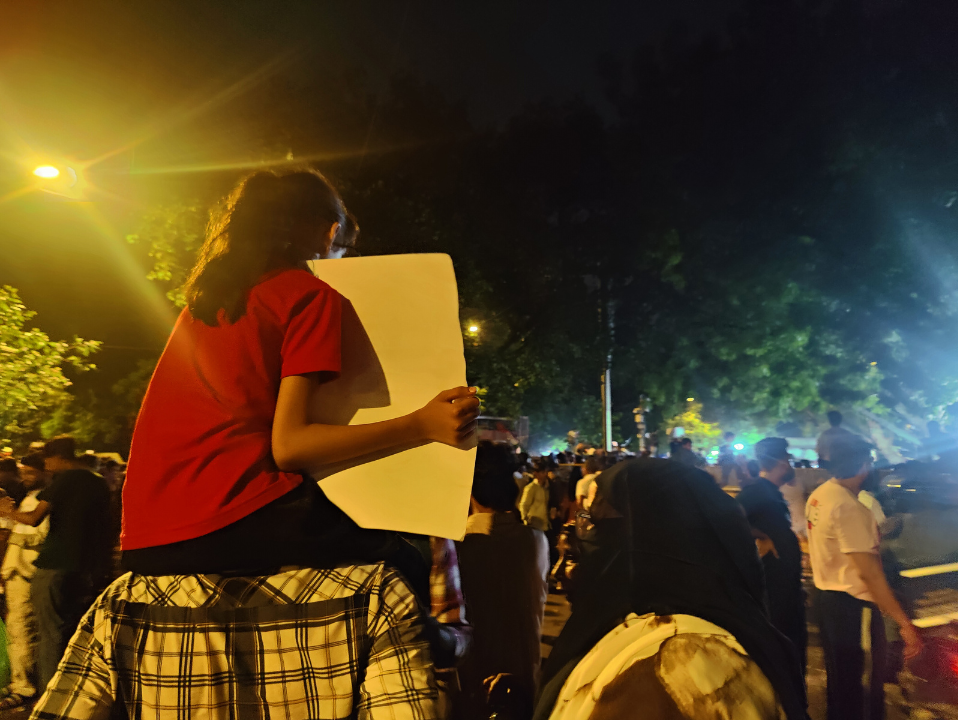
Photo by Shruthi Manjula Mohan
The March to Parliament
While there is no record of the number of people who participated in the protest on 20 July, the day of the Sansad Chalo march to Parliament, drone footage and multiple videos confirm massive footfalls. Many participants had travelled from other cities and spent the night on pavements, even as heavy security and seasonal rain welcomed them.
The protestors were met with brutal force from the police, Rapid Action Force and other armed law enforcement agencies. Besides the customary lathi charge, tear gas, electric batons, wooden sticks with nails, even pellet guns were used by the authorities to try and disperse the crowd. Women protestors were equally at the receiving end.
Police detained and dragged several women into police stations. Female RAF officials were spotted beating a mother and daughter with lathis. Young girls complained that their clothes were torn by police officials during detention. A video of Additional Deputy Commissioner of Police-Delhi Sandeep Lamba slapping a young woman surfaced. In another video, another officer identified by social media users as Naveen Rathi was seen shoving a lathi into a young woman’s buttocks.
A 21-year-old woman was critically injured and on ventilator support at Dr Ram Manohar Lohia Hospital. In another incident, a 32-year-old woman from Gurugram was hit by a pellet gun. “Police have been absolutely brutal. They have fractured the skulls of many students who were protesting here. Even a 15-year-old girl was brutally beaten up by a male police officer,” CJP founder Abhijeet Dipke alleged in a video he posted on Instagram.
Similar reports of brutal force and illegal detention surfaced in Mumbai, Bihar and Kolkata, where protestors were lathi-charged. For CJP spokesperson Sudhir Sangwan the greatest disappointment was the behaviour of female police officers. “We have all seen how men abuse women and how they are powered by the systems of patriarchy. But I’m equally appalled by women officials harassing young girls and women,” he said.
Several pictures and videos surfaced showing young girls and women fighting back, even shielding male protestors from male officers. Human chains were formed to help each other. A video of 27-year-old Rhiya Ahir standing in front of a Mumbai Police van to stop it from taking protestors away went viral.
Shruthi’s video from the Jantar Mantar protests
Wide Support
Far from deterring dissent, the unprovoked brutality gained the movement even more followers. Rafiya from Turkman Road in Old Delhi was not at Jantar Mantar on 20 July, but decided to show her support the day after. On 24 July, at 1am, she was there again with her three daughters. “When I watched the videos, I wondered what kind of country we have become. These people in uniform must have children as old as these protestors at their homes; how could they unleash such brutality on other children?”
Among the many celebrities who showed up in solidarity was Shabana Azmi, who visited the protest site twice. Arundhati Roy visited multiple times, and in an opinion piece for The Wire later wrote, “For the first time in years, it feels wonderful to be Indian…. Just when hope seemed lost, they came. Young roaches riding in on the rain. The progeny of the unholy union between a judge and a joke.”
Women politicians who made their way to Jantar Mantar included Brinda Karat, Dimple Yadav, Mahua Moitra, Supriya Sule, Sagarika Ghose, Iqra Hassan, Priya Saroj, Atishi Singh, KK Shailaja, Mumtaz Patel and Sushma Andhare. From the entertainment industry, Swara Bhaskar, Sonakshi Sinha, TJ Bhanu and Huma Querishi marked their presence. The movement drew lawyers, economists, academics, farmer leaders and social media influencers, too.
Radhika, 28, a resident of Uttam Nagar in west Delhi, made four visits to the protest site after 20 July. The mother of two daughters says she was horrified by the violence against children, young women and students. “On 12 May 2019, I went to the polling booth in my bridal wear. It was my first time voting, and my vote was for the BJP. But today, at 2:30 am, I came to deliver these bags of food to the people at Jantar Mantar, showing my dissent to the government,” she said.
Standing with his son, who held a placard, 43-year-old Mohan Yadav said, “If we brought Modiji to power and he is the head of the country, he should have taken care of our well-being. Instead he went against 65% of the youth of the country. In front of my eyes, so many women and children were beaten up. I felt really sad.”
After the Protest
On 25 July, Dharmendra Pradhan resigned as education minister. The government said the families of students who died by suicide due to the NEET exam malpractices would be compensated, that criminal charges against the protestors would be withdrawn, and that those in detention would be released. The protest was subsequently called off.
However, for the women who stood up to protest publicly, vicious online harassment began. Several handles posted photos of the girls and women who had spoken out with the caption “teach her a lesson”. After days of trolling, a 15-year-old from Noida posted a video with folded hands, apologising for an earlier reel in which she had abused the Prime Minister. Noida Police had registered an FIR against the child under sections of the laws relating to insult, public mischief and defamation, which was later transferred to the Delhi Police. The girl and her mother were forced to vacate their residence after crowds started to gather around their house.
For model Rhiya Ahir, comments on her clothing and lifestyle followed. A coordinated campaign to circulate morphed images of her began, along with false claims that she sold explicit content. Her mother was also attacked. Ahir eventually filed multiple complaints, including cyber complaints.
For many young girls, this was their first experience of participating in a protest. A 20-year-old who posted a “fit check” video from Jantar Mantar received an inbox full of threats from men. “Some said they would report me to the police so that I would be beaten or arrested. Men called me degrading names, made sexually explicit remarks, mocked my body and threatened violence. Some said I should be ‘taught a lesson’. Others simply warned: ‘Your turn will come’,” she said.
CJP spokesperson and lawyer Ratna Singh also received threats. “My DMs are filled with death threats, abusive messages, and an endless stream of hateful tweets and comments. It doesn’t bother me anymore,” she said.
Cropped and AI-manipulated images of young women who had attended the CJP protests with captions calling for them to be identified and reported were circulated. Young women deleted posts, locked their accounts and stopped answering calls from unknown numbers.
Against great odds, women made their way to the protest site or showed their support online. They raised their voices and were met with physical and online violence–a cause and effect that underscores the fact that in India, women are still expected to obey rather than dissent.
Shruthi Manjula Mohan is a media and policy professional based in New Delhi.
Edited by Shalini Umachandran