
On the Campaign Trail, Speeches About Respect but No Proof of Regard for Women
“If he wants to know what misogyny looks like in modern Australia, he doesn’t need a motion in the House of Representatives, he needs a mirror,” Julia Gillard, former Prime Minister of Australia, told Parliament in October 2012, in a speech directed at then opposition leader Tony Abbott.
Most women in Tamil Nadu will not deliver a speech like Gillard’s as a platform to speak is rare. Even the women who do hold office often find themselves spoken over. Chennai mayor and Dravida Munnetra Kazhagam (DMK) member R. Priya, who was elected unopposed in 2022, has been patronised and interrupted by male councillors in council meetings, including her own party members. A male DMK councillor said she “embodies masculine strength to lead,” The News Minute reported. Priya is the first Dalit woman mayor of the city and only the third woman to hold the post, which has been occupied by Indians since the late 1930s.
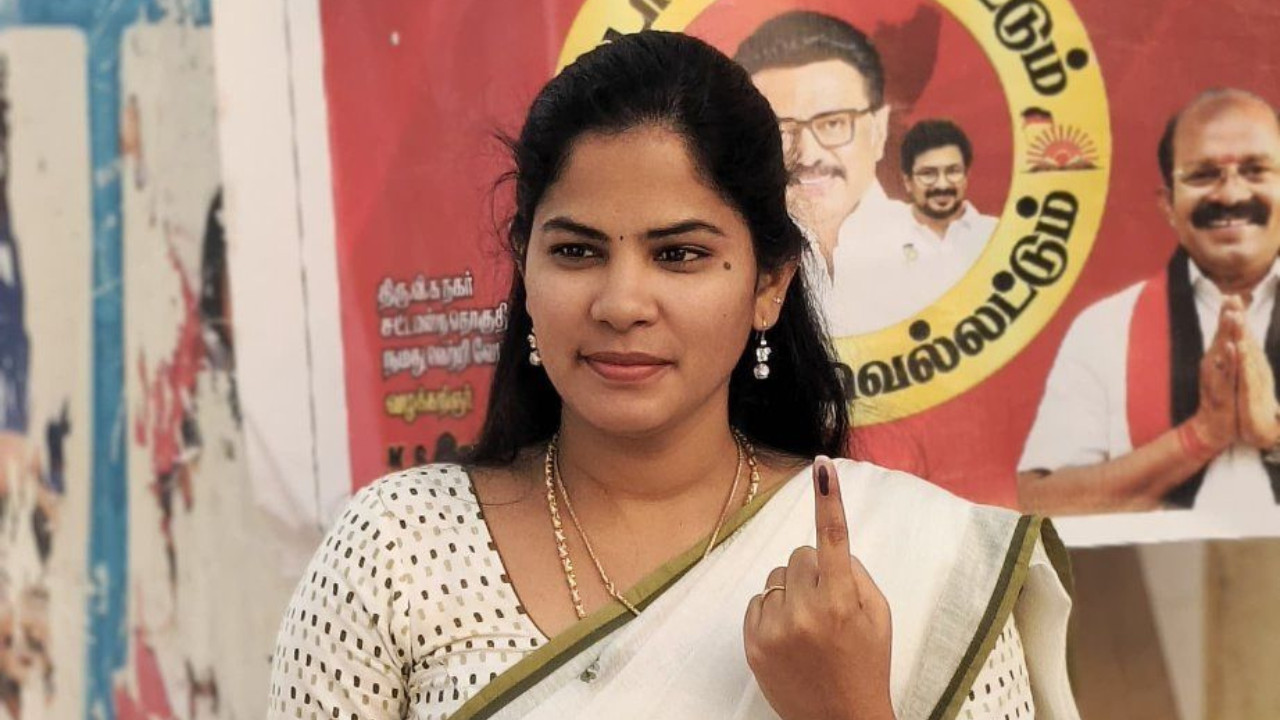
In the run-up to the 17th Tamil Nadu Assembly election, polling for which took place on 23 April 2026, similar patterns of misogyny played out over and over, reinforcing that women are valued as voters but not as leaders. Women comprised 2.93 crore voters, while 2.83 crore were men and 7,728 third-gender persons. Women may outnumber male voters but just 443 of the total of 4,023 candidates in the fray for 234 seats were women, that’s just a little over 11%. For the first time in Tamil Nadu since Independence, the state had an 85% voter turnout, The Hindu reported.
The run-up to the polls has been instructive when it comes to attitudes towards women in leadership in Tamil Nadu politics. Days before the election, Bharatiya Janata Party (BJP) leader and former Telangana governor Tamilisai Soundararajan framed the DMK and Congress opposition to delimitation as anti-women and a denial of “an important opportunity to advance women’s representation, including the push by the Modi government to implement women’s reservation.”
The Women’s Reservation Bill, which guarantees one-third of legislative seats for women, was unanimously passed in 2023 as the Nari Shakti Vandan Adhiniyam. Linking it to the Constitution (131st Amendment) Bill to increase the number of seats in Lok Sabha to 850 and therefore to the Delimitation Bill (subsequently withdrawn), which would have been disadvantageous to Tamil Nadu, is disingenuous.
But Soundararajan’s espousal of equal opportunity for women becomes even more ironical when you look at what the leaders on her side of the aisle were saying in the months before the election. In February, BJP Karur president V.V. Senthilnathan made obscene and derogatory remarks about Congress Karur MP S Jothimani during a demonstration in the town, and police registered a case.
In March, at a rally for women’s safety and law and order in Villupuram, AIADMK Rajya Sabha MP C. Ve Shanmugam, in a clumsy attempt to criticize TN chief minister M.K. Stalin’s ‘Tell Us Your Dream’ initiative, asked the crowd whether Stalin would fulfil his dream of marrying a woman actor, and named the actor. The men around him laughed; there was applause. (All-India Anna Dravida Munnetra Kazhagam or AIADMK is part of the National Democratic Alliance that includes the BJP).
A few months earlier, as various media outlets reported, at a booth committee meeting, Shanmugam had taken a pot shot at the DMK, saying, “They will provide mixers, grinders, goats, cows for free, and why, they might even give a wife for free to each person.” After AIDWA registered a complaint saying the comment insinuated that women were commodities, the Madras High Court later observed that the remarks were not misogynistic “by any stretch of imagination”.
In March, former AIADMK minister Dindigul Srinivasan mocked the DMK’s free sari distribution scheme, saying, “Women are asking how would they wear it without petticoat,” a comment reported by multiple media outlets.
BJP Tamil Nadu president and former minister Nainar Nagendran told reporters that actor and Tamilaga Vetri Kazhagam (TVK) chief Vijay should “come out of (a female actor’s) house” to understand the realities of politics. The female actor issued a legal communiqué on her social media handles. Nagendran apologized.
Earlier this year, when Vijay’s wife Sangeetha Sornalingam filed for divorce, alleging adultery on his part, both she and the female actor named in the petition were trolled. Sangeetha was called a DMK pawn, the female actor a homewrecker.
It’s not only the politicians who abuse women in politics: In an interview to a YouTube channel last month, Ponraj Vellaichamy, an advisor to former President A.P.J. Abdul Kalam, referred to TVK’s women cadre as “sex workers.”
Other parties are not far behind in this race to the bottom. The DMK has disciplined or suspended members over the years for misogynistic and insensitive comments. Many others have got away with similar statements. Ten days ago, a Dalit woman from Manachanallur in Trichy died by suicide after DMK workers allegedly abused her in public during the distribution of gifts ahead of the election. Over the decades, prominent Tamil women politicians, including former chief minister J Jayalalithaa and Lok Sabha MP Kanimozhi, have been subjected to name-calling and innuendo.
Last year, after Naam Tamilar Katchi leader Seeman belittled Periyar’s comments on feminism, CPM leader U Vasuki said, “His (Seeman’s) speeches are steeped in blatant patriarchy. He often uses the word ‘aanmagan’ in his speeches.” ‘Aanmagan’ translates from the Tamil to indicate those with qualities that are traditionally associated with masculinity.
Vijay’s TVK had a manifesto that framed women’s issues around cash transfers and free bus travel as well as a marriage assistance scheme, Annan Seer Thittam, which translates to ‘elder brother’s wedding gift scheme’, casting the state in the role of an older, and dare we say, patriarchal, brother.
This pattern of refusing to unlearn making casteist and misogynistic remarks reflects a political culture that offers token support to women while denying the basic right to dignity. Yet to focus only on the loud, public vulgarity of men in power is to miss the quieter, more insidious violence enacted through hierarchy. The casual misogyny of the campaign trail is not separate from the structural abandonment of women. As the examples of Priya, Jothimani and Jayalalithaa and others show, to be elected to lead does not free one from such treatment.
The abuse extends beyond gender when caste comes into play. In 2020, it was reported that S Rajeswari, president of Therukuthittai panchayat in Cuddalore and a Dalit, was forced to sit on the floor during meetings by the male caste Hindu vice-president, while others sat on chairs. The same year, M Sukanya Vadivel, president of Kalipalayam panchayat in Tirupur and a Dalit, reported sexist remarks and caste-based harassment from her deputy soon after taking office. About a decade earlier, in 2011, then Thalaiyuthu panchayat president (Tirunelveli district) and Dalit leader P. Krishnaveni was brutally attacked and left for dead for challenging caste hierarchies. A 2023 study by Evidence, a Madurai-based non-profit that works for the rights of Dalits and tribal communities, found that Dalit panchayat presidents in Tamil Nadu face 30 different kinds of discrimination. Women presidents had faced physical assault at the hands of dominant caste men. Of the 79 women who participated in the survey, four had faced sexual harassment.
CPM MLA K Balabharathi captured it perfectly when she told The New Indian Express last month, “Dravidian parties have one foot in the present century, advocating women’s rights and welfare schemes, and the other in the past century — in their attitudes towards women.”
To extend Gillard’s “mirror” statement, we are not dealing with a single reflection but a hall of mirrors that does not reflect the truth so much as refract and distort patriarchy into a thousand ugly angles. Women are often told to shatter the glass ceiling. But before they can reach the ceiling, someone must smash these mirrors.
Diya Maria George is a Chennai-based journalist who works for The New Indian Express.
Edited by Shalini Umachandran