

What President Murmu means for Adivasi women
I have known President Murmu since 2015 when she became the governor of Jharkhand. The first female governor from my community, she is also the state’s longest serving governor.
Murmu holding the highest office in the country is truly a matter of pride for the Adivasis. That year, 2022, when she took office, I was often asked to speak on tribal issues at many programmes. During a ‘talent night’ at one workshop, I imitated her oath-taking ceremony. But what has it really meant for the Adivasi women of India? If one really wants to understand the significance of Murmu’s position as the first citizen of India from a gender lens, one needs to look at political situation of women and Adivasis at the ground level.
Have Adivasi woman, or even women in general, got the dignity they deserve? Across the country, 200 million Adivasis depend directly on the forest and the land for their life and livelihood—and it is no secret that the current model of “development” is destroying forests and depriving Adivasis of their fundamental rights. There are laws aplenty to protect tribal rights: the Panchayat Extension to Scheduled Areas Act, 1996, the Fifth and the Sixth Schedule, the Forest Rights Act 2006 and various other laws. Despite this, the structural injustice faced by tribal communities at the administrative level persists. The blatant dance of state-sponsored violence that took place in Manipur will be remembered forever by the tribal community. The fact that the ruling party seems unmoved by such a large-scale inhumane incident, and the lack of visible empathy from the President towards the women of her own community, reveals the tokenism associated with the position.
The tribal community to which President Murmu belongs, the Santhals, is still one of the most marginalized communities in India. Ideally, any political movement should advance the community and society from which it originates, but the Bharatiya Janata Party’s “presentation” of a tribal president to the nation shows a politics of tokenism. In 2024, only 10 Adivasi women were elected to the 543-member Lok Sabha. This reveals that tribal women still have a long way to go in the political sphere.
Those in power want to project that they have handed down something exemplary to the tribal community, but behind their actions lie projects like mining and deforestation in the biodiverse Hasdeo Aranya in Chhattisgarh and the Supreme Court’s order to declare Asia’s largest sal forest, Sarandha forest in Jharkhand’s West Singhbhum district a wildlife sanctuary, directly impacting the livelihood and culture of the tribal community.
A report by the National Campaign Committee for the Eradication of Bonded Labour, covering 950 rescued bonded workers and 1,000 others across 19 states, found that 13% of recused bonded labourers rescued are Scheduled Tribes. Not much could be done in terms of rehabilitation and compensation, the report observed, because FIRs were not filed in 80% of the cases. This is enough to show what Adivasis have received in terms of social justice and where the political will is directed.
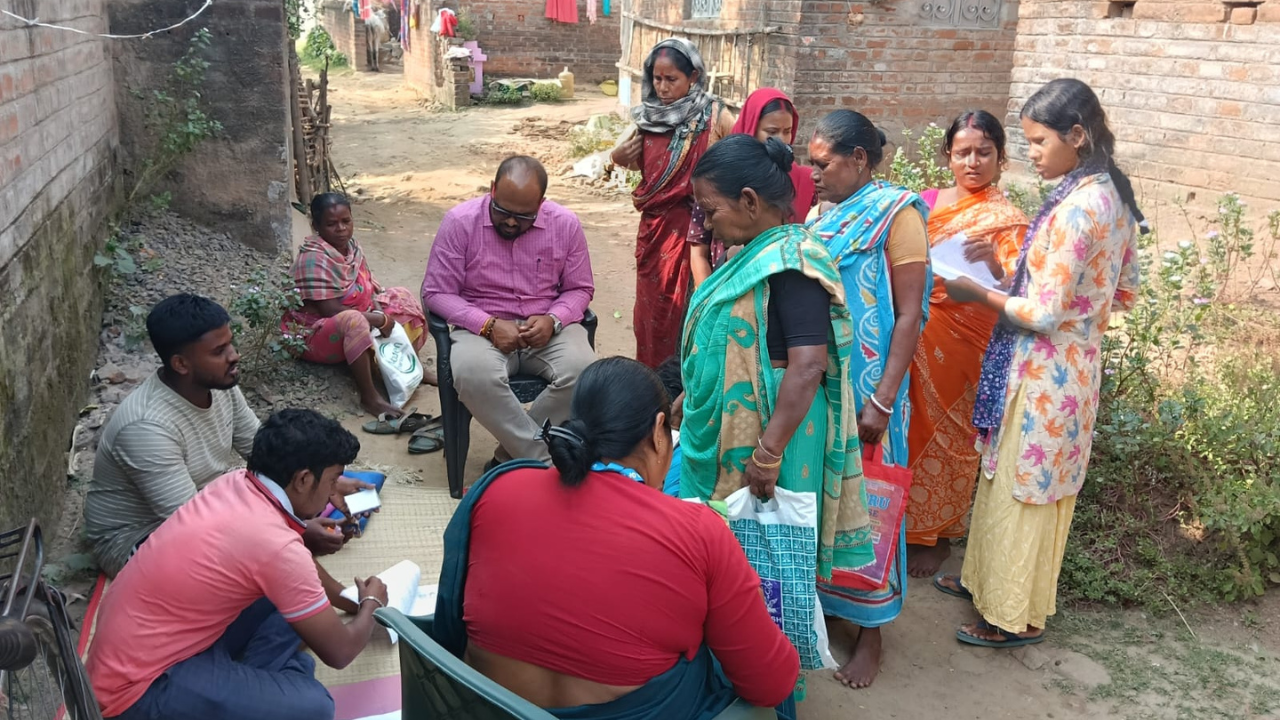
In Kolibera village in Jharkhand’s Simdega district, 1338 km from Delhi, I met 56-year-old Veyanti Kandulna. Kandulna was a domestic worker in Delhi for 30 years before returning to her village in Jharkhand. She had come with her neighbour, 51-year-old Jyoti Lugun, to the Gram Sabha meeting that I was also attending. Both had come to see the village sarpanch and deposit their pension forms. I asked them how they felt about having a tribal woman president. “I can’t say much. I heard that the President is from Santhali community. There are not many Santhals in this area,” said Kandulna. She proceeded to tell me that since she worked in Delhi for years, cleaning and cooking for others, she didn’t even have a voter ID in her village.
Lugun knew that an Adivasi woman is the President, but didn’t have much idea about what else is happening in the country. “We stopped subscribing to the newspaper after my father-in-law passed away,” said Lugun before asking me to fill out their pension forms, which I did.
In many regions of India, leadership positions for women in general and Adivasi women in particular, are limited to being the president of the women’s wing or the Mahila Morcha, never to mainstream positions like district, block or Panchayat presidents. The condition of women, especially tribal women and girls, who have been exploited for cheap labour because of their language, lifestyle, attire and simplicity, remains the same as it was before an Adivasi woman became the president in 2022.
I see on a daily basis that the tribal community is still not empowered to decide for themselves, whether in the political, industrial, judicial or technology sectors. Even today, decisions for tribal community are made by people from other communities.
Even with an Adivasi woman as the president, issues of water, forests, land, animals and large-scale exploitation of women in the tribal community, who constitute 8.6% of the country’s population, remain unchanged. The kind of systemic change that the Constitution envisioned for the protection, development and empowerment of tribals, has still not come into force. Only when Aadivasis break free from narrow identities cast by others—such as “Naxalites in the forest” and “migrant labourers and domestic workers in cities”—will they be able to achieve equality at the political, social and cultural levels.
Augustina Soreng is a journalist from Simdega district in Jharkhand and the 2025-26 NWMI Fellow.
Please find the original article in Hindi here
Translated by Ravleen Kaur
Edited by Shalini Umachandran