

How Indian Women Vote—And Why
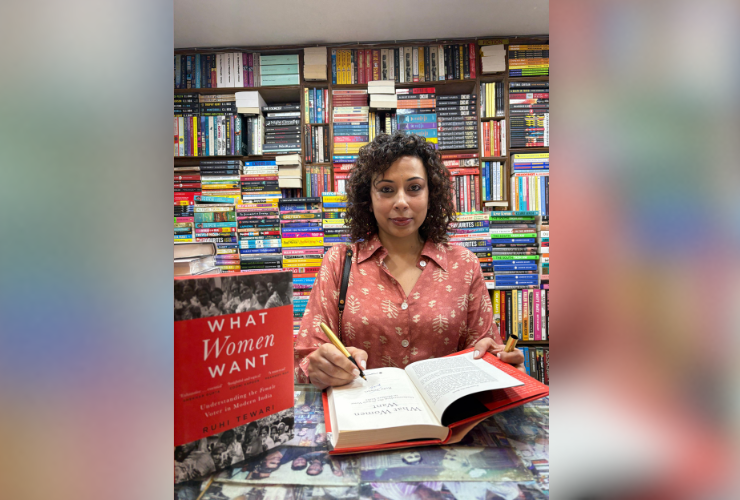
In the 2019 and 2024 Lok Sabha elections, female electors’ turnout surpassed that of men. Who is the female voter in modern India and what does she want? Journalist Ruhi Tewari explores this and more in her debut book, What Women Want: Understanding The Female Voter in Modern India (Juggernaut, October 2025). Tewari has spent nearly two decades covering policy and politics. Beginning with the Rajasthan Assembly election in 2008, she has covered four Lok Sabha elections, over a dozen Assembly elections and several by-elections. The book, a result of several years of field reporting, brings together a journalist’s field notes, research and experts to weigh in on the female voter in India. The idea took shape during Tewari’s reporting for the 2017 Uttar Pradesh Assembly election when she found young, first-time women voters to have distinct clarity of thought on politics and elections, and ability to state exactly what they wanted. Edited excerpts from an interview:
Female voters in India wear multiple identities, but is there a common thread which binds them?
The thing with female voters, as you rightly point out, is that they grapple with multiple identities, which often contradict and complement each other—identities of caste, faith, class, education, social backgrounds, regional status, ethnicity. Gender is just one among the many identities. But what makes women a slightly more bonded group than others is the common history of marginalisation, of constantly being deprived of basic essentials, and of being kept at the bottom of the ladder socially, economically as well as politically.
They’re second to men across identities and that is one binding factor, which makes women an easier group to target in a slightly more homogeneous fashion. They have common vulnerabilities which have not been addressed so far.
At which point did political parties begin viewing the female voter with seriousness? What do you make of this ‘wooing’ as the media frequently calls it?
I look at the evolution of women voters in India in terms of four distinct phases in the book. When we had the first general elections in 1951-52, many women had to be struck off the electoral rolls because they refused to enroll under their names, and wanted to be enrolled through a male relation—fathers, brothers or husbands. Thus, even though there was universal franchise, the situation was lopsided.
In 1962, where gender-wise data is available, the gap between men and women voter turnout was over 16 percentage points—a vast gap. What happened from the 1950s to 1970s, essentially, was that India had just become independent, and there were so many other concerns occupying the minds of the political class, the policymaking class and the chattering classes. The economy had to be rebuilt. Social fabric had been destroyed with Partition. There were wars, an agrarian crisis, famines. In the 1970s, there was so much unemployment and poverty. The focus was on all these. Hence, there was never a realisation that women could be a separate, independent voter group, which needed to not just be uplifted, but also be given more electoral importance by talking to them directly as stakeholders.
Something changed in the 1984 election (held in two phases in 1984 and 1985) just after the assassination of Indira Gandhi, when women turned up in large numbers to vote. The voter (turnout) gap between men and women reduced drastically to 2.6 percentage points. That was a huge drop where essentially the difference had remained in the nine to 11 percentage points range. It showed how women had the potential to come out and influence an election in a big way. Congress won with an astounding mandate, and that seeded the idea of women being or having the potential to be a powerful voting bloc in the minds of the political class. It became a defining moment in some ways.
Has there been a shift in strategy? Political parties have handed out grinders and pressure cookers, and now they promise free travel on public transport and cash transfers. What do women voters make of all this?
I wouldn’t say there’s been a shift. I would say there’s been an evolution. Jayalalithaa became synonymous with populism because of giving mixer-grinders. I’ve spoken to women in Tamil Nadu who explained how their lives in the kitchen changed. Mixer-grinders liberated them from the drudgery of traditional forms of grinding. The idea is to fix gaps in the lives of women and to make their lives easier…. Free public transport, for instance, is a big help for women when they want to go out to work or study. Cash transfers are very useful.
As far as wooing is concerned, the political classes is doing it out of electoral opportunism. There is no philanthropy. However, in that lies a subtle and very significant change: the fact that the political class is now talking directly to women, whether you call it wooing, serenading or whatever one might want to. In that process, women have been made direct stakeholders and now feel invested in the process. Why are more women turning out to vote? Because they think they are a part of the policymaking scenario where politicians are talking to them and are targeting them with specific policies and with specific promises.
What do women voters themselves make of this? So, there are two ways to look at it. One is that women voters are happy. The prime minister is addressing them directly, thinking of policies for them. It’s an important part in the evolution where they are no longer just a perfunctory mention in speeches under the bhaiyon aur behno (brothers and sisters) umbrella. They are now a very important part of speeches, of manifestos, of policymaking.
Are women looking at the welfarism as freebies? I don’t think so. They don’t look at it as bribes to go and vote. They are looking at it as useful instruments to address gaps in their lives and they are going to appreciate it and reward it as long as these measures genuinely helps elevate their lives.
What are some of the major differences in how young women (in their 20s) view elections and voting as compared to older women?
One significant difference between younger and older women voters is what they expect and how they view their identity. For younger voters, they are looking largely at themselves as individuals. Older women voters look at their family as one unit. Whenever they ask for something, it is about employment, schools for their children, family. Something for the household. The young woman voter is clear she’s looking at something for herself. Whether it’s safer roads, more infrastructure, employment opportunities or scholarships. This young woman voter is not as attracted to household doles as the older women are. She has a full life ahead of her, and she doesn’t want to look at herself just within the household. She is expecting more from outside the household, and that’s how she’s approaching elections and her voting decisions as well.
Ruhi Tewari
How significant is caste, religion and urban vs rural as deciding factors for female voters?
Women voters are not a homogeneous unit by any stretch of imagination. They are riddled with conflicts of various identities and all of them are critical identities. The big question is when they go to vote, do they vote just as women or do they vote as Dalit women or Brahmin women or Muslim women or Hindu women? And that’s a slightly more complex situation.
All women feel disenfranchised as compared to men. There is no sect, no identity in which women feel superior. As I’ve said earlier, that is one binding factor. However, in cases where there are other identities that make them even more vulnerable, and place them in an even more precarious situation—being a minority or being a Dalit—then those identities tend to supersede the identity of gender. Similarly, for backward castes or women in conflict regions. It’s a double whammy because those factors plus gender put them at the bottom of the pyramid.
Today, very few parties are seen as completely anti-backward caste, but there are parties that are seen as completely anti-minority. So for Muslim women, for instance, religion becomes a very important factor, particularly in today’s environment. All these identities merge as well as sort of split from each other. When they go to vote, it’s a question of which vulnerability, which disadvantage is greater.
Among female voters you met, what were the attitudes towards female politicians?
So far, there is no concrete evidence to show the gender of the politician matters to a significant extent to the woman voter. For instance, Jayalalithaa was or Mamata Banerjee is popular among women not by virtue of being women, but because they speak for women. Similarly, Nitish Kumar, Narendra Modi, Shivraj Singh Chouhan, M.G. Ramachandran (MGR) and Nandamuri Taraka Rama Rao (NTR), all these male leaders are or have been popular among women because their policies helped women.
If gender was an important factor, then Sonia Gandhi would have been a much bigger leader among women. Neither is Mayawati. Nor Smriti Irani. Nor Priyanka Gandhi Vadra. The point is how much you’re able to connect with women voters, speak their language and give them what they want. Having said that, I think soon enough, women will start asking why there are not enough women in policy and the political sphere.
Did you come across any significant data point with regard to female voters over the past two decades?
When the Congress-led UPA came to power in 2004, it was an important landmark because it passed the Mahatma Gandhi National Rural Employment Guarantee Act (MGNREGA) which mandated a third of the workforce be women. The Act had a lot of provisions for women, whether it was creches or ensuring safety at workspaces. The 2009 election gives you a very significant data point. The gender gap between men and women (voter turnout) plummeted to 4.42 percentage points, which was the lowest ever except for that aberration in 1984 just after Indira Gandhi’s assassination, which tells us that MGNREGA empowered the rural woman to a significant extent and gave her own source of money. Women earlier couldn’t go to work; there was no work in the village and they couldn’t step outside the village to work. MGNREGA gave them opportunities right next to their homes. This gave them economic independence. It gave them a greater say and dignity in the household, and it gave them the confidence to vote as per their wishes and thinking.
The second big data point is, of course 2019, when the gender gap, was completely closed in voter turnout. In fact, it was reversed to a marginal extent. That’s essentially because, in 2014, the whole concept of women voters at the national level erupted and there was so much conversation around women voters.
The Prime Minister was constantly talking about them, whether it was about toilets in the house, clean cooking fuel, Beti Bachao Beti Padhao. The Opposition was quick to latch on because they realised something was changing at the national level. That made women even more invested and interested in the process and hence there was a greater desire to go and vote, which showed in the 2019 election.
What has media coverage of the female voter been like in the last two decades?
I can speak from my experience when I covered my first election in the winter of 2008 in Rajasthan. As journalists, we are always taught to give a balanced perspective and to ensure the voice of every stakeholder is included. But it was always a struggle to find enough number of women to get their perspective because they were either reluctant to speak or not allowed to speak, or disinterested or scared. Or unaware. So many factors prevented women from being a voice. From that to today, when women are at times even more eager, expressive and clearer than the male voter, I think that evolution has also been seen by the media and reflected in media coverage. The only thing I would caution the media against is constantly looking at women voters as politicians do—as mere labharthi or beneficiaries and thinking they’re happy to receive freebies, and not understanding the true reason behind them being appreciative of these welfare policies.
Annie Philip is an independent journalist in Bengaluru. Her work can be found at https://anniephilip.contently.com/
Edited by Shalini Umachandran