

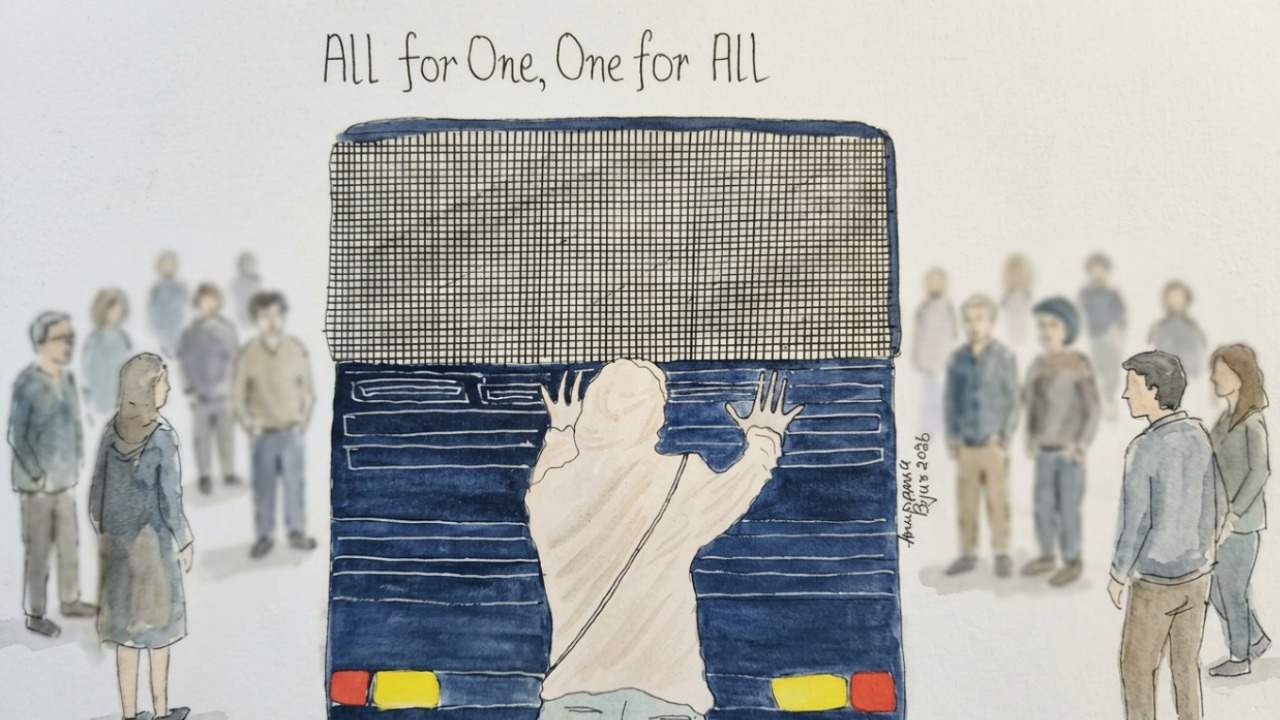
All for One, One for All
By:
Almost every protest or movement unwittingly has one enduring image which becomes the photograph through which millions understand the entire movement.
In July, to me, that image was of Rhiya Ahir, a 27-year-old model-actress, who stood alone in front of a police van, filled with young Mumbaikars who had been rounded up by the police as they came out on the streets to protest the NEET question paper leaks and ask for reforms in the education system.
The protests, which began in Jantar Mantar in Delhi in response to a call by the the newly formed, satirically named Cockroach Janta Party (CJP), grew into India’s biggest mobilisation of students and other youngsters in recent times. There were similar gatherings in many places across the country.
Three student leaders from the All India Students’ Association (AISA) – Neha Bora, Aameen Amitoj, and Manish Kumar – and well-known educator and activist Sonam Wangchuk were on an indefinite hunger strike at Jantar Mantar in support of the movement’s demands. Their fast went on for over 20 days.
Ahir was obviously not the only woman protestor in Mumbai. She was neither an organiser nor a spokesperson. But among the hundreds and thousands of women who came out to protest in several different cities, she and her defiant act became hard to ignore.
This image may well join the inspiring gallery of other images of quiet but strong resistance by women in India and elsewhere that have become iconic, like those of the “Dadis” of Shaheen Bagh in 2019-20, Danuta Danielsson swiping a neo-Nazi with her handbag at a protest in Sweden in 1985, Ieshia Evans confronting two policemen in full riot gear during a Black Lives Matter protest in the US in 2016, and so on.
(For more such iconic images check out ‘Photos of women protesting around the world’ – and ‘12 iconic images of defiant women’)
Unfortunately, such images can very quickly turn from inspiring to inconvenient: many women whose images went viral during the recent Jantar Mantar protests have been subjected to gender-based hostility, harassment and cyber bullying.
A woman’s defiance, silent or noisy, is still uncomfortable in many societies, including ours. Yet, whether the women seen at Jantar Mantar over the past few weeks came as participants or spectators, every one of them has become an enduring symbol, earning respect for their bold and unflinching views, resilience and courage.
InkSights is a monthly art series by NWMI member Anupama Bijur viewing current affairs through a gender and news lens.
TAGS
More From the Section

Of Brands, Bralettes and Backtracking
All for One, One for All

Climate Change Hits Her Hardest


Doxing, Deepfakes and Digital Harassment
