
From Shelves to Shadows: J&K’s War on Books

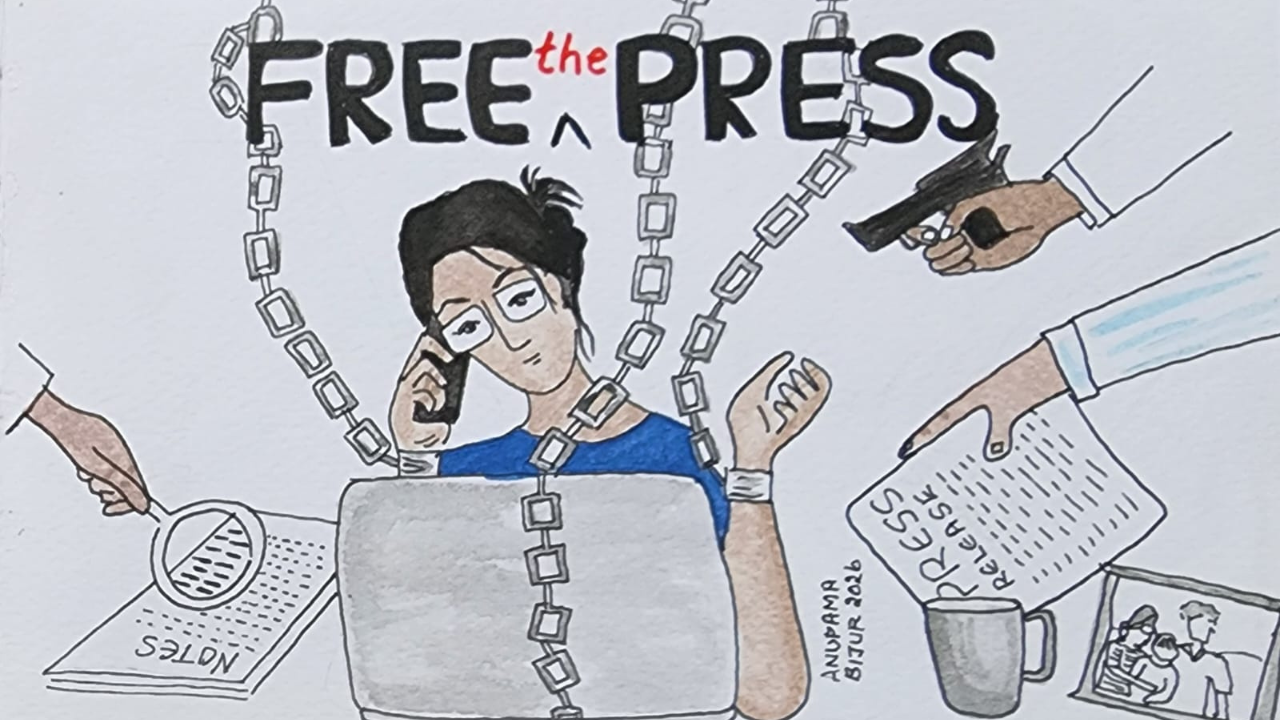
Image courtesy: Petra from Pixabay
The Jammu and Kashmir government has banned 25 books on Kashmir, many of them acclaimed works by eminent authors, alleging that they “excite secessionism” and endanger India’s sovereignty and integrity. The writers covered by this ban include A.G. Noorani, Arundhati Roy, Victoria Schofield, Sumantra Bose and Network of Women in Media, India (NWMI) member Anuradha Bhasin.
Following the government order issued on August 5 by the Home Department, which comes under Lieutenant Governor Manoj Sinha, the J&K Police raided booksellers and publishers across the Kashmir Valley on August 7.
The order coincided with the sixth anniversary of the announcement of the abrogation of J&K’s special status in 2019. Interestingly, the ban has been issued while the Chinar Book Festival organised by the government is underway on the banks of the Dal Lake in Srinagar. Union Minister Dharmendra Pradhan inaugurated the festival on August 2 in the presence of Chief Minister Omar Abdullah and the Lieutenant Governor. The fest is on till August 10.
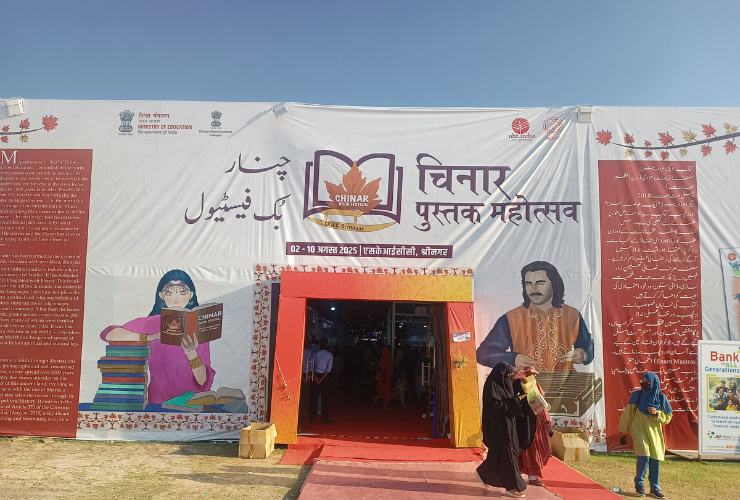
Chinar Book Festival in Srinagar, Jammu and Kashmir. Photo by Safeena Wani
“The resolution of the Kashmir issue lies not in guns and lathis, but in the pen,” the Minister had said at the launch function. Later on the sidelines of the event, he added that the government will come up with schemes from the Centre to develop the culture of libraries in Kashmir. Meanwhile, after the ban order was issued, the J&K Police conducted raids on book stalls set up at the Chinar Book Festival.
Earlier this year, the J&K Police had raided several bookshops in Kashmir and seized certain books by the Jamaat-e-Islami (JeI) founder Maulana Maududi. The J&K chapter of JeI was banned in 2019 under the Unlawful Activities (Prevention) Act (UAPA) by the Ministry of Home Affairs, for alleged “activities against the security, integrity and sovereignty of the nation” and “fuelling secessionism in J&K.” Al-Jihad Fil Islam by Maududi also figures on the latest list of books banned by the government.
A reader from Kashmir who asked not to be named said that banning books in today’s time seems “strange” especially when PDF versions can be accessed online.
“This ban will create an unnecessary hassle and hamper the studies of students who are pursuing research in political science, international studies and regional studies as they will have to let go of important reference material,” said a student who spoke on condition of anonymity.
Several political parties and leaders in Kashmir have condemned the ban. The government order has also received flak from civil society members and sections of social media users across the country.
Responding to a social media post, Jammu and Kashmir Chief Minister Omar Abdullah distanced himself from the ban.
“Get your facts right before you call me a coward, you ignoramus. The ban has been imposed by the LG using the only department he officially controls – the Home Department. I’ve never banned books and I never would,” Abdullah wrote on X (formerly Twitter). The current CM may not have banned any book, but his grandfather and the founder of the National Conference (NC), Sheikh Muhammad Abdullah, did ban Kis Ka Lahu Hai Koun Mara by Shabnum Qayoom in the late 1970s.
The former chief minister of J&K, Mehbooba Mufti, condemned the latest government action, pointing out that democracy thrives on a free exchange of ideas. During her own tenure as CM from 2016 to 2018, Mufti had briefly banned a local English newspaper. This week she wrote on X: “Banning books cannot erase history, it only fuels division. In Kashmir, suppressing democratic voices and fundamental freedoms deepens alienation and mistrust. Censorship does not silence ideas, it amplifies their resonance.”
The high-profile cleric and politician, Mirwaiz Umar Farooq, also criticised the current ban, writing on social media that such actions “will not erase historical facts and the repertoire of lived memories of people of Kashmir. It only exposes the insecurities and limited understanding of those behind such authoritarian actions, and the contradiction in proudly hosting the ongoing Book Festival to showcase its literary commitment!”
The ruling NC spokesperson Imran Nabi Dar asked the government to “present the specific paragraphs” written in these books that they claim excite secessionism or threaten India’s integrity and sovereignty. “If the government is able to do that, it may be justified, otherwise, everybody has the right to read literature. Some of these books have been written by prominent authors like A.G. Noorani and published by reputed global publishing houses,” Dar told reporters in Kashmir.
The Home Department in its official notification stated that “available evidence based on investigations and credible intelligence unflinchingly indicate that a significant driver behind youth participation in violence and terrorism has been the systematic dissemination of false narratives and secessionist literature by its persistent internal circulation, often disguised as historical or political commentary, while playing a critical role in misleading the youth, glorifying terrorism and inciting violence against Indian State.” (sic)
The notification further said that “this literature would deeply impact the psyche of youth by promoting a culture of grievance, victim hood and terrorist heroism.” (sic)
“Some of the means by which this literature has contributed to the radicalization of youth in J&K include distortion of historical facts, glorification of terrorists, vilification of security, religious radicalization, promotion of alienation, pathway to violence, terrorism, etc,” the notification added.
According to the notification, the 25 books identified for this ban attract the provisions of Sections 152, 196 and 197 of The Bharatiya Nyaya Sanhita, 2023. “Now, therefore, in exercise of the powers conferred by section 98 of the Bhartiya Nyaya Sanhita 2023, the Government of Jammu and Kashmir hereby declares publication of 25 books, forming Annexure “A” to this Notification, and their copies or other documents to be forfeited to the Government,” (sic) the notification added.
This is a complete list of the 25 banned books:
- Human Rights Violation in Kashmir by Piotr Balcerowicz and Angnieszka Kuszewka | Published by Routledge (Manohar Publishers and Distributors)
- Kashmir’s Fight for Freedom by Muhammad Yusuf Saraf | Published by Feroze Sons Pakistan
- Colonizing Kashmir by Hafsa Kanjwal | Published by Stanford University Press
- Kashmir Politics and Plebiscite by Dr Abdul Jabbar Gockhami | Published by Gulshan Books
- Do You Remember Kunan Poshpora by Essar Batool and others | Published by Zubaan Books
- Mujahid Ki Azan by Imam Hasan ul Bana Shaheed | Published by Markazi Maktaba Islami
- Al Jihad Fil Islam by Maulana Maududi | Published by Markazi Maktaba Islami
- Independent Kashmir by Christopher Snedden | Published by Manchester University Press and Sanctum Books
- Resisting Occupation Kashmir by Haley Duschinski, Mona Bhat, Athar Zia and Cynthia Mahmood | Published by University of Pennsylvania Press
- Between Democracy and Nation by Seema Kazi | Published by Oxford University Press and Women Unlimited
- Contested Lands by Sumantra Bose | Published by HarperCollins
- In Search of a Future by David Devadas | Published by Viking Penguin
- Kashmir in Conflict by Victoria Schofield | Published by Bloomsbury Academic India
- The Kashmir Dispute by A.G. Noorani | Published by Tulika Books, Chennai
- Kashmir at the Crossroads by Sumantra Bose | Published by Pan Macmillan India
- A Dismantled State by Anuradha Bhasin | Published by Harper Collins
- Resisting Disappearance by Ather Zia | Published by Zubaan Publishers
- Confronting Terrorism by Stephen P. Cohen | Published by Penguin India
- Freedom in Captivity by Radhika Gupta | Published by Cambridge University Press
- Kashmir (The Case for Freedom) by Tariq Ali, Hilal Bhat, Angana P. Chatterjee, Pankaj Mishra and Arundhati Roy | Published by Verso Books
- Azadi by Arundhati Roy | Published by Penguin India
- USA and Kashmir by Dr Shamshad Shan | Published by Gulshan Books
- Law and Conflict Resolution in Kashmir by Piotr Balcerowicz and Angnieszka Kuszewka | Published by Routledge (Manohar Publishers and Distributors)
- Tarikh i Siyasat e Kashmir by Dr Afaq | Published by Karwan e Tahqiq o Saqafat
- Kashmir and the future of South Asia by Sugata Bose and Ayesha Jalal | Published by Routledge (Manohar Publishers and Distributors)
Safeena Wani is a journalist based in Jammu and Kashmir. Her work has appeared in various national and international platforms, including Al-Jazeera, SCMP, The New Humanitarian, Waging Non-Violence, India Spend, The Federal, Boomlive, Newslaundry and others.
Edited by Anna MM Vetticad