

Session 4: Breaking the cycle-Media’s role in highlighting multi-dimensional strategies to end child marriage, in collaboration with UNICEF
Unboxing child marriage in India: Insights from Assam and beyond

From left: Priyanka Tupe, Journalist, BehanBox, Dr. Gitanjali Ghosh, Associate Professor of Law, Tezpur University, Tora Agarwala, Independent Journalist, Dr. Vikram Srivastava, Advocate and Founder, Independent Thought and Rokibuz Zaman, Journalist, Scroll.in
Panellists:
Dr. Gitanjali Ghosh, Associate Professor of Law, Tezpur University
Dr. Vikram Srivastava, Advocate and Founder, Independent Thought
Priyanka Tupe, Journalist, BehanBox
Rokibuz Zaman, Journalist, Scroll.in
Moderator: Tora Agarwala, Independent Journalist
This panel threw up several insights, including that child marriage in India affects both boys and girls, though it predominantly impacts women. The discussion centred around Assam — the state where the NMWI meet was convened — which has made some significant efforts to end this practice. Tora Agarwala, a freelance journalist reporting on the northeast, moderated the discussion.
Multimedia journalist Priyanka Tupe, based in Maharashtra, began reporting on child marriage during the COVID-19 pandemic. Through her work, she had found that the practice escalated at the time, with the boy’s or man’s family coming to the girl’s house, and quickly finishing the ceremony on that day.
She spoke about the many reasons parents commit to a child marriage. Poverty, migration, caste, class were major factors, Tupe said. Another was safety. When women worked outside the house, there was no adult at home to take care of the children, frequently seen in sugarcane cutters in Maharashtra. They would decide to marry their daughters off.
She also cited the case of Monalisa Bhosle, the 16-year-old rudraksha-bead seller, whose video at the Kumbh Mela went viral. Such unwanted virality could possibly force a family to fix their daughter’s wedding, a researcher had explained to her.
Climate change was also impacting the practice. One example she gave was of water shortages. Since it was usually the women who carry water, marriage was a way of bringing in more hands to do this.
Agarwala then took the discussion to Assam and its police crackdown on child marriages in the state. She asked Guwahati-based Rokibuz Zaman, who works with Scroll, on his experience of covering child marriage in Assam had been.
Zaman revealed that thousands of people were arrested for being involved in child marriage. These marriages have social consent, many of which stem from romantic relationships, and the use of Protection of Children from Sexual Offences (POCSO) law in such relationships, is questioned by the community.
Zaman said that in the crackdown, 62% of the families were Muslim, mostly from remote areas, staying mainly on the banks of the Brahmaputra. The tea tribe communities were also impacted. There was a strong pushback to this crackdown, with women gathering in front of police stations, cursing the Chief Minister Himanta Biswa Sarma and the government.
Dr. Srivastava questioned the use of the word ‘crackdown’, saying it was focused on the illegality of what is a social issue. He also said journalists needed to stop using the word crackdown, because it was just the police doing its job. This was an issue of patriarchy, he said, not religion.
Agarwala then turned to Dr. Ghosh, asking her if the existing legal framework still lacked in some way. “I wish I could answer this in a simple sentence…. The legal age of consent is now 18, and it has its own journey, just like the legal age of marriage. [The year] 1978, was when we finally got a law or act to fix the minimum age for marriage. There are many more laws that deal with child marriage,” she said, adding that all those involved in a child marriage are accountable, from the one who initiated the marriage to the attendees at a ceremony.
Awareness, she said, is not just about telling people about one part of a law. “When we talk about awareness, we need to also give
awareness on annulment, divorce, rights of the children. There are gaps in the law.”
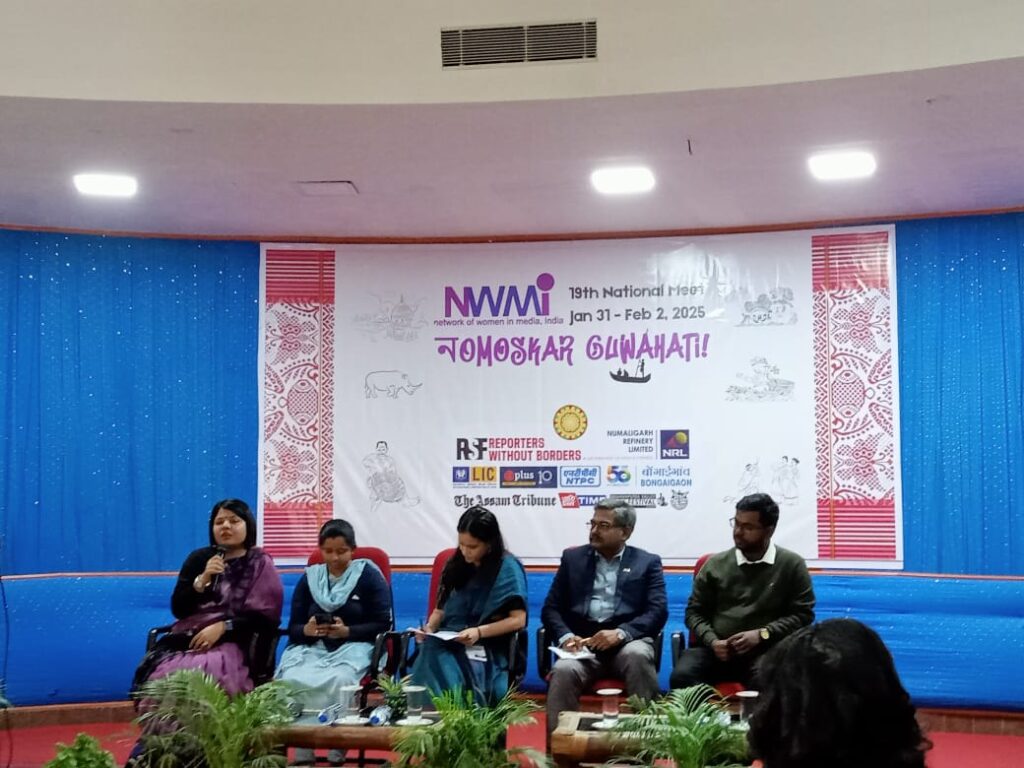
From left: Priyanka Tupe, Dr. Gitanjali Ghosh, moderator Tora Agarwala, Dr. Vikram Srivastava and Rokibuz Zaman.
Tupe and Zaman extended that thought, saying reporters also needed training across legal and socio-economic factors. They drew attention
to the Climate Brides podcast by Reetika Revathy Subramanian, who worked as a Senior Research Associate on the Successful Intervention
Pathways for Migration as Adaptation research project at the School of Global Development, University of East Anglia.
The panel felt that media reporting on child marriage was one step, but organisations needed to take it one step further and also get
involved in generating awareness, because while the government could make and enforce the law, the press had the power to create behaviour
change.
Report by Sindhu Nepolean
Edited by Sunalini Mathew


