

Session 1: Regional Media-What Lies Ahead in the Digital Age?
Local traditional media and digital media are co-existing
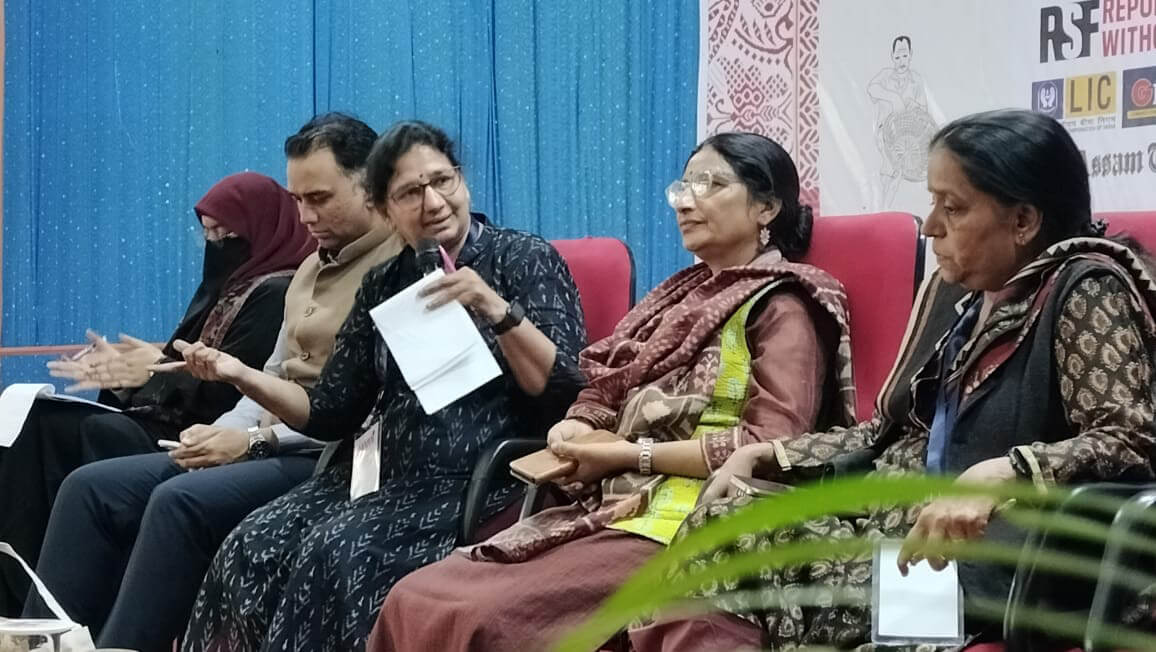
From left: Humaira Nabi of Kashmir Life, Sunit Jain, director and publisher of GPlus, Guwahati, C Vanaja, senior journalist from Hyderabad, Nazni Rizvi, journalist with Khabar Lahariya, Uttar Pradesh and Madhya Pradesh and CG Manjula, senior journalist from Bangalore.
“Traditional media and digital media are co-existing at the local level,” said CG Manjula, senior journalist from Bangalore, during a panel discussion on “Regional media: What lies ahead in the digital age?” at the three-day national meeting of the Network of Women in India (NWMI), held in Guwahati, Assam, earlier this year.
Other members of the panel were Sunit Jain (director and publisher of GPlus, Guwahati), Nazni Rizvi (journalist with Khabar Lahariya, Uttar Pradesh and Madhya Pradesh) and Humaira Nabi of Kashmir Life. The session was moderated by C Vanaja, senior journalist from Hyderabad. Kasturi Das introduced the panel. The panel examined the challenges and opportunities they transition in the digital age.
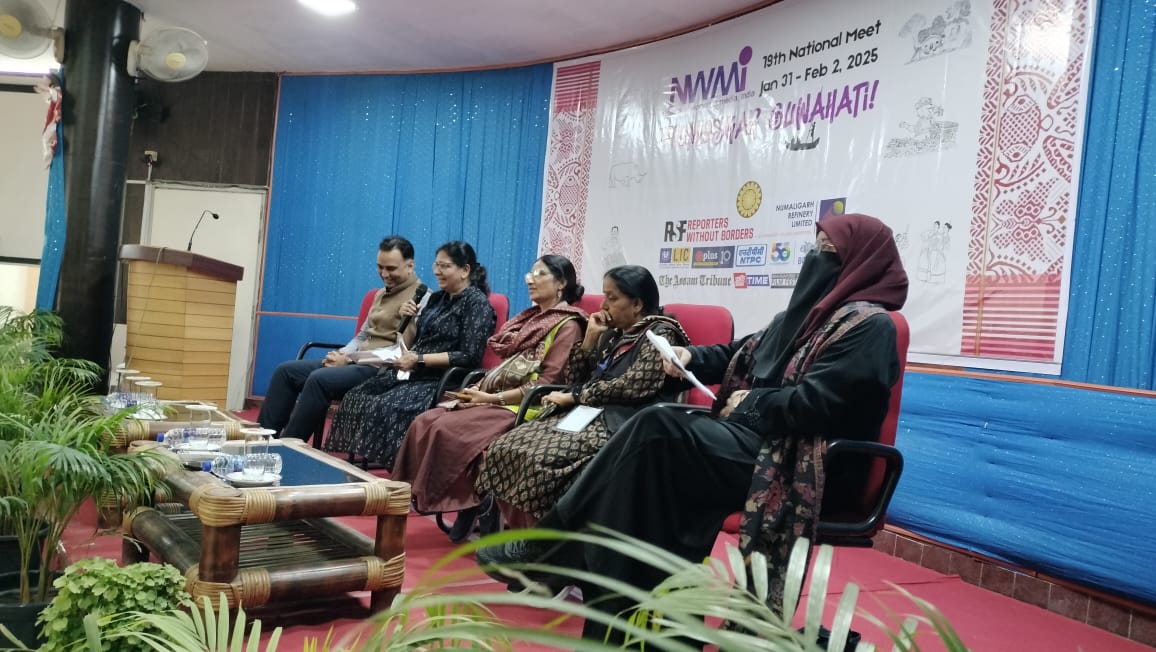
From left: Sunit Jain, moderator C Vanaja, Nazni Rizvi, CG Manjula and Humaira Nabi.
Vanaja began by saying that both legacy and other local language media have their own spaces. According to her, several journalists have managed to restart their careers with digital media, which present new opportunities.
Manjula agreed, saying legacy media may be facing challenges from digital media but are far from extinct. According to her, print media still make an impact on society, with neo-literate people and those without easy access to the Internet still relying on them for information. Also, she said, with fake news and disinformation rampant in the digital space, including social media, people still rely more on newspapers. Regional language print media are also adapting, not only launching digital editions (often behind a paywall) but also adopting better design, providing explainers as well as news analysis, opinion pieces and special supplements pegged on major events. Legacy media are also venturing into video stories and webinars, which means journalists increasingly need to develop multiple skills. According to her, both regional and digital media are co-existing at present and may do so in the foreseeable future. However, she said, we need to adapt and transform to stay relevant.
Vanaja pointed out that if newspapers do not survive, digital media may also not survive since most of them feed of the digital editions of legacy newspapers. Many of them function more like news aggregators, with newspapers as the primary source of news.
Nazni Rizvi shared the story of her newspaper, the well-known, 23-year-old women-run platform for rural news, Khabar Lahariya. “When Khabar’s print edition was stopped in 2014, we were all shocked and scared that we would lose our identity,” she said. “But we entered into the digital space in 2016 and slowly learnt to survive as thrive as digital media.” Today, KL reaches five million people every month through multiple digital platforms. It has a network of 25 women reporters across 16 districts of Uttar Pradesh and Madhya Pradesh, who run a hyperlocal, video-first news channel, broadcasting news primarily to audiences in remote areas. “Learning never ends,” she pointed out. “We learn and also teach. Earlier rural women were reluctant to talk on camera. But we all have learnt on the job. Earlier officials used to speak to the newspaper. Now they don’t want to talk on camera.”
Talking about the weekly magazine she works with, Humaira Nabi said, “We started as a 36-page magazine and we were earning well. However, after August 2019 and, even more so, during Covid, it became difficult to get advertisements. The Media Policy 2020 of the state administration made the situation worse. The magazine was forced to reduce the number of pages by more than half and became a 16-pager.” According to her, the editor then decided to dive into the digital space in order to survive. However, the space is quite crowded with an over-saturation of media backed by the government. “The line between traditional media and digital media is now blurred,” she said.
Sunit Jain, founder of GPlus, a hyperlocal news portal based in Assam, pointed out that there is a need to deconstruct the term “regional media”. According to him, regional media are different from local and hyperlocal media. He also flagged the fact that the Northeast is a widely misunderstood region. Pointing out that regional media in the Northeast attempt to cover the entire region, which is made up of several states with people belonging to different tribes, speaking different languages, etc., he said there is no common context: the states just happen to be situated near each other, the issues they face are different. “I don’t see any prospect of growth in regional media, at least in the northeastern region. The Times of India and The Telegraph both started north-east editions but they did not work. According to him, the same goes for digital portals attempting to be regional. He believes that the future lies in hyper-local media that represents the power of community and brings people together. As he sees it, the reason why the hyper-local GPlus has not only survived for 11 years but is also thriving is because it focuses on telling stories about the lives of the local people and their concerns in an attempt to make citizens’ lives better. He said they have built up a community of contributors who are also consumers. “The future of journalism and journalists is hyper-local,” he concluded.
A lively discussion followed before the session came to an end.
Report by Varsha Torgalkar
Edited by Ammu Joseph


