

Public Meeting at the NEDFI Convention Centre
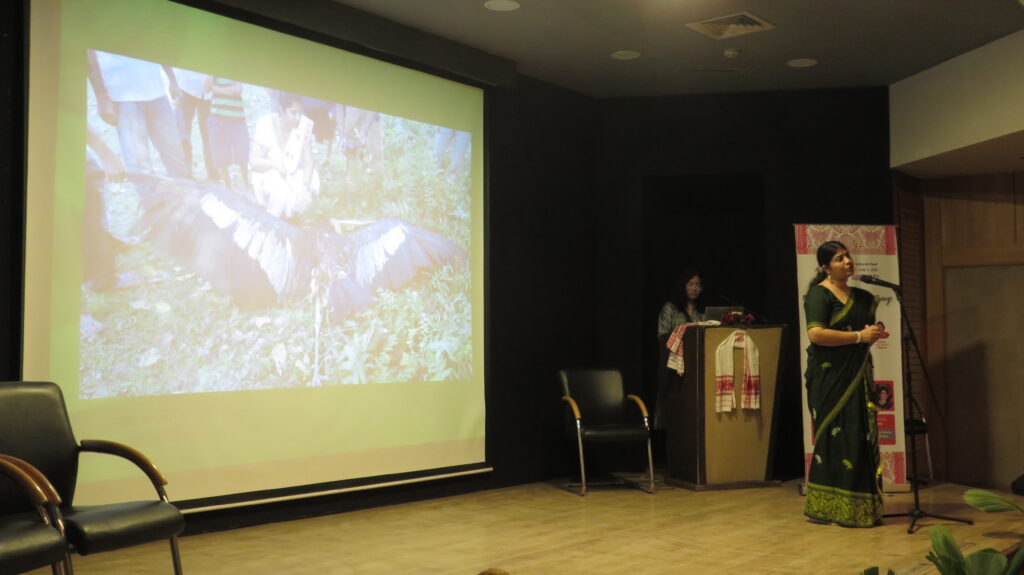
Dr Purnima Devi Barman, wildlife biologist makes a presentation on the Hargila at the NWMI public meeting in Guwahati.
Crafting Conservation: The Hargila Story
The meeting started with a presentation by Dr Purnima Devi Barman, a world-renowned wildlife biologist based in Guwahati. She spoke about her journey to save the Hargila, or the Greater Adjutant Stork, from near extinction. These scavenging birds with a crucial ecological role were regarded as bad omens by the Assamese who would destroy their eggs and nests.
Dr Barman was moved by the alarming condition of the Hargila to launch an awareness programme in the villages, using a multipronged approach — with women’s empowerment, children’s education, and community awareness — to protect the bird. “We were bringing together science, pride in one’s traditions, culture, education and awareness,” she said. She even formed a “women’s army” to protect the birds. The Hargila Army now has some 10,000 women. The population of this bird has almost tripled in Assam which now has the largest nesting colony of Hargila in the world.
Songs of Devastation
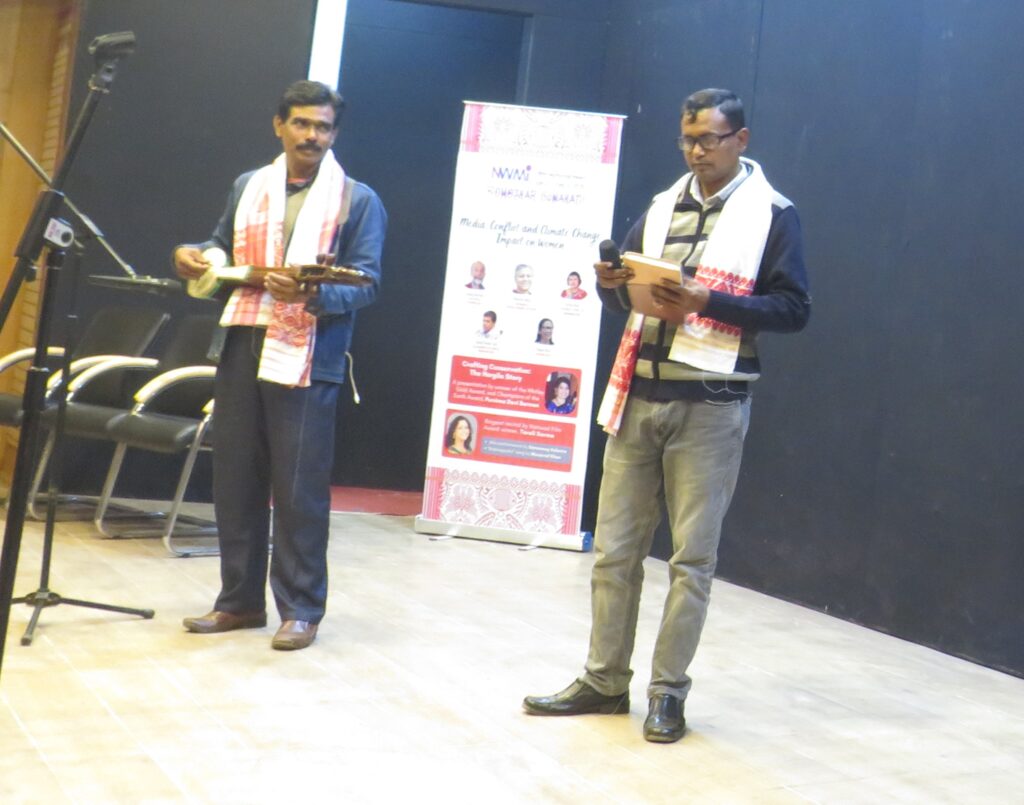
Singers Musharaff Khan and Saiful Hussain from Torabari Village in Barpeta followed Purnima Devi’s story of optimism with ballads of mourning. They sang movingly about the devastation caused by the shifting river Brahmaputra that destroyed their homes and lands, and rendered the villagers climate refugees.
Climate journalist Chandrani Sinha, a member of Guwahati NWMI, has documented several such climate songs along the Brahmaputra.
Media, Conflict and Climate Change: Impact on Women
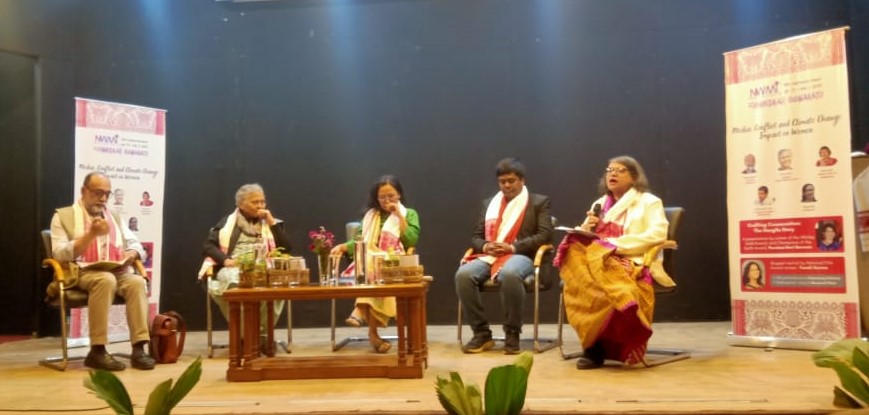
From left: Sanjoy Hazarika, journalist and author, Monisha Behal, Chairperson, North East Network, Tongam Rina, Deputy Editor of The Arunachal Times, and Kamal Kumar Tanti, Director of the Centre for Environment and Climate Action Foundation and Durba Ghosh, Bureau Chief, Press Trust of India.
The centrepiece of the public meeting was a panel discussion on the intersection of media, conflict and climate change, and the effects on women, a topic critically important to the Northeast region.
The panellists were: Sanjoy Hazarika, journalist and author; Monisha Behal, Chairperson, North East Network; Tongam Rina, Deputy Editor of The Arunachal Times, and Kamal Kumar Tanti, Director of the Centre for Environment and Climate Action Foundation. The discussion was moderated by Durba Ghosh, Bureau Chief, Press Trust of India.
Looking back on his vast experience as a journalist covering the Northeast, Mr Hazarika said it had become increasingly difficult for media to report on real issues.
Mr Hazarika spoke on the impact of climate change with changing weather and rain patterns in the region. He described the abject living conditions of people living on the shifting riverine islands known as “char” — a geography unique to Assam. Char dwellers must change homes several times a year, due to flooding and erosion. The chars do not have basic amenities like electricity supply or roads, and have little or no access to healthcare. There are about 2,500 such islands along the Brahmaputra and they are home to 3 million people or roughly eight percent of the state’s population.
How does one meet the critical needs of people in this region? “The simplest way is to treat river as an ally and use it as a resource,” Mr Hazarika said. He described his work conceptualising the “boat clinic”. In places where people find it almost impossible to reach healthcare facilities, these facilities can be brought to them in boats. The Assam government took Mr Hazarika’s idea forward, and today people in 13 districts of the state are served through 15 boat clinics. These clinics have contributed to bringing down maternal mortality in the region.
Monisha Behal spoke on how women had been hit by conflict in the Northeast. She identified three major fallouts: extremely low productivity, complete lack of access to education, and an absence of institutional mechanisms like management schools etc.
Ms Behal pointed out that the Northeast has always faced marginalisation. People here feel isolated and alienated, and the youth has an extreme sense of frustration.
The conflict has taken a huge toll on women here, she said, and described her own experience of working at the grassroots during the armed conflict in Nagaland. She saw that men were almost entirely absent from the fields. Before the conflict when men and women worked in the field together, they made their work easier by singing together. That ended with the conflict. Men went into hiding because of the excesses of the army. Children were withdrawn from school. Women had to deal with extreme fear and mental trauma.
Speaking of the impact of climate change, she said the incidence of agricultural pests has gone up in the region. Seeds are not germinating, and there’s water scarcity, leading to a decrease in agricultural productivity. All this has led to loss of livelihoods. “When livelihood goes, women are subjected to abuse,” she said.
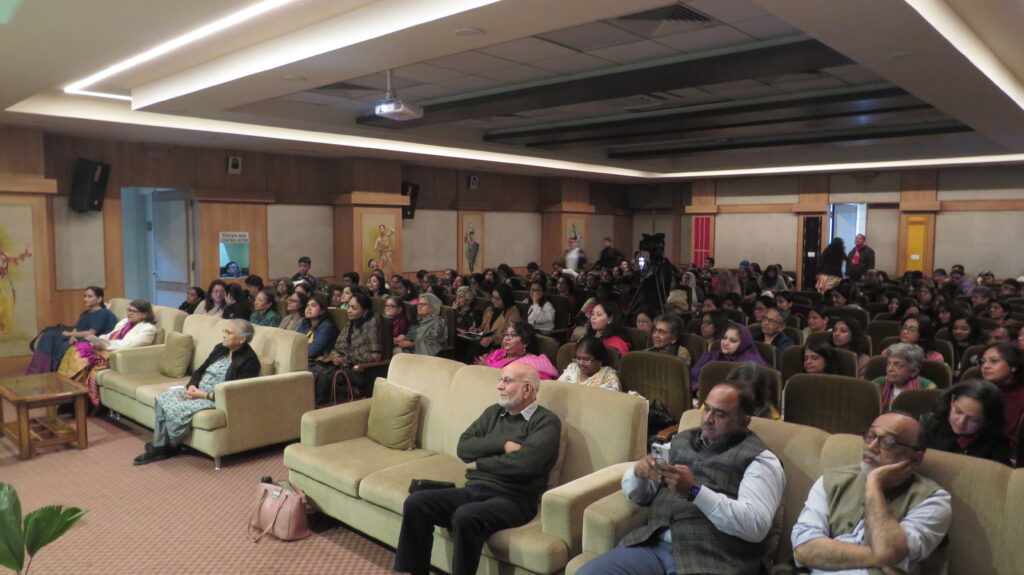
NWMI members and audience at the public meeting.
Ms Behal emphasised the strength of collective power. She said women needed to work together in order to make a real difference, whether dealing with conflict or with climate change. She spoke of her efforts in empowering women in the rural areas of the Northeast by spearheading millet conservation and production, an initiative engaging women. The Green Revolution went a long way towards ending hunger, but destroyed millet production. NorthEast Network procured indigenous varieties and created seed banks, encouraging millet cultivation. “The whole point was to be able to grow our own food,” she said.
Tongam Rina spoke about the issues from her home state, Arunachal Pradesh, where protests are going on against the 11,000 Megawatt hydropower project in the Siang and Upper Siang districts. Planners at the Centre have disregarded local concerns and sentiments. Such issues are not highlighted in the national media.
She said the dam was being forced upon the people of her state without a proper feasibility study. “There has been no study on the river basin,” she said.
Tongam who has covered these mostly women-led protests pointed out that while they had been raising valid questions, nobody was answering them. “It is China who answered by declaring that they are building the world’s biggest dam,” she said with her unique deadpan humour.
Kamal Kumar Tanti from the Centre for Environment and Climate Action Foundation spoke about his study of trends in rainfall and climate change. He also raised the issue of corporate interests dictating to farmers, resulting in the loss of several indigenous varieties of crops. “We used to have 3,000 varieties of rice… Now, no more,” he said. Mr Tanti called for a return to indigenous knowledge systems to help mitigate the impact of climate change, and to protect biodiversity and livelihoods.
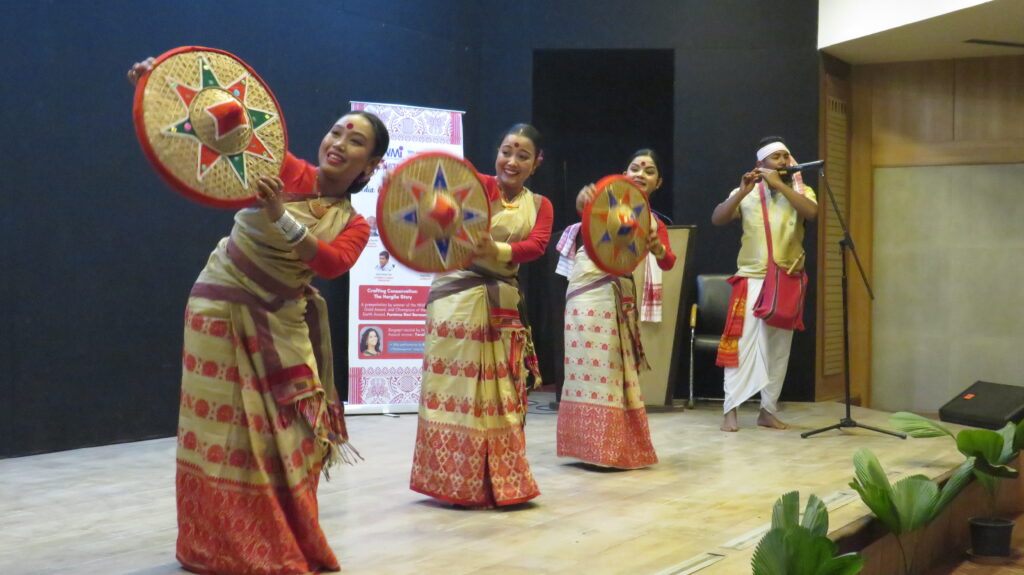
The public meeting ended with a scintillating performance of the Bihu dance traditionally enacted to celebrate the arrival of spring.
Report by Anuradha Sharma
Edited by Sandhya Srinivasan


