

Crafting Conservation: The Hargila Story
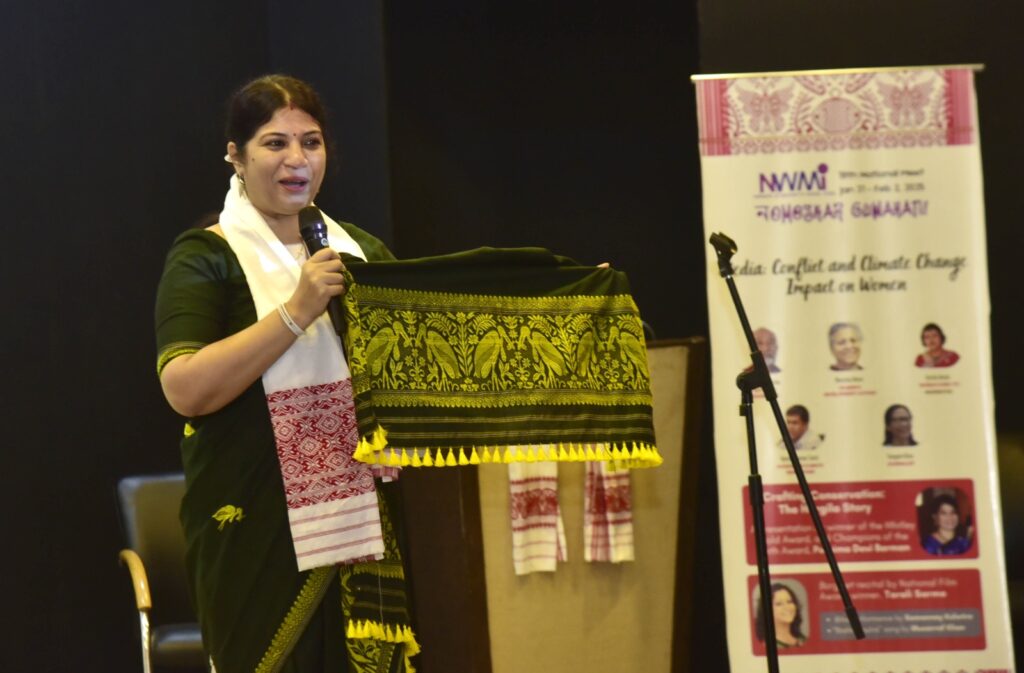
Purnima Devi Barman at the public meeting
“Takh takh…. Takh takh…”
The public meeting started with a clatter of bird calls.
Renowned conservationist Purnima Devi Barman captured the audience’s attention by mimicking the distinctive clatter of the Hargila or Greater Adjutant Stork, and invited everyone to join in. Soon the hall was filled with the sounds of the Hargila bird.
Dr Purnima Devi Burman’s passion for the Hargila was evident everywhere. Her earrings, pendant, and her Assamese mekhla chador all had intricate Hargila motifs. Her team wore papier mache Hargila hats. She even requested the audience to forget her name and call her Hargila bird. Indeed, she is popularly known as Hargila Baideo or Hargila Sister.
Purnima Devi narrated her inspiring journey to protect the Hargila. This scavenging bird was despised by the community. Its nesting areas would routinely be destroyed, and it had dwindled in numbers until Purnima Devi launched a campaign for its revival. Despite facing resistance, anger and ridicule, she persevered, engineering a remarkable shift in the public’s perception of this bird.
The story goes back to 2007. Purnima Devi had gone back to academics after giving birth to twin daughters. She was completely focused on completing her PhD when a distressing incident changed the course of her life.
She learned that villagers were cutting down a tree containing a nest of baby Hargila birds nearby. When she asked why they were cutting nesting trees during the breeding season, they told her Hargila birds were a bad omen and did not deserve to live. She learned that cutting down Hargila nesting trees was a common practice across rural Assam. (Assam has the largest of the three Greater Adjutant Stork breeding sites in the world.)
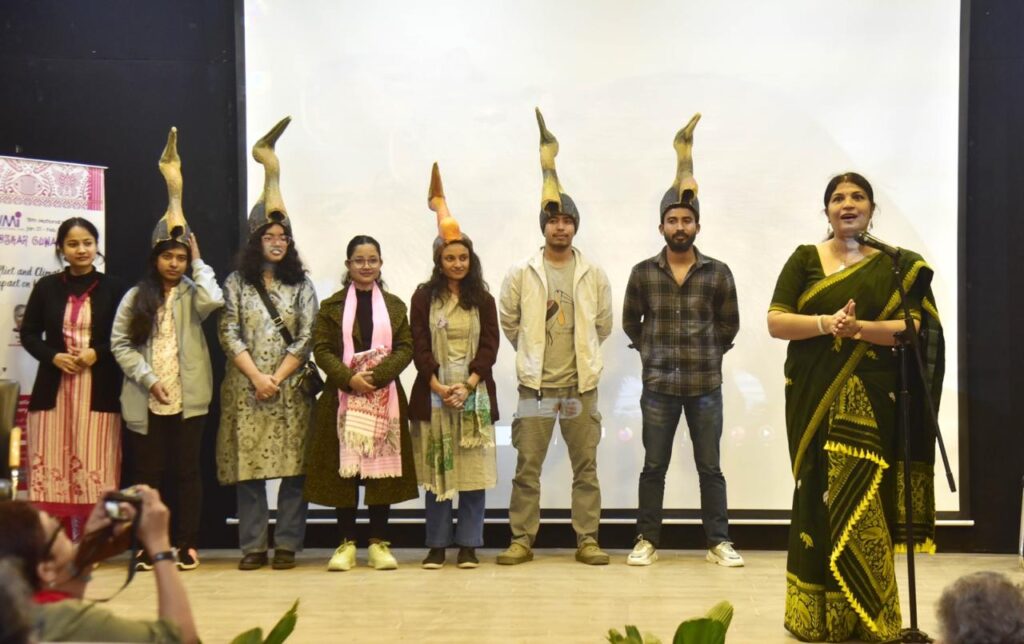
Purnima Devi Barman and her team
Purnima Devi was initially taken aback by the villagers’ attitude but she came to understand that people prefer to protect attractive animals and birds; they are not interested in species like the Hargila bird, though it plays a vital role as a scavenger, and is part of nature’s cleaning crew. This mindset needed to be changed.
At this point her PhD took a back seat and she started work to protect Hargila birds. She did go back later and obtained her doctorate. She started calling small meetings of women in villages in Kamrup district, near Guwahati, to raise awareness about the bird. Initially the women laughed but their interest was piqued when she started organizing cooking festivals and other small activities.
At the meetings the women would play a game called “Mangalmoyshanti Jaal”, or “Web of Harmony”, to raise awareness about the interconnectedness of all living beings in Nature.
Noting that when Hargila birds prepare for their babies, they are called bad omens, whereas humans celebrate expectant mothers with baby showers, Purnima Devi started organising traditional baby showers for Hargilla birds, and even weddings of Hargila birds, using the events as opportunities to raise awareness about the species.
Eventually she formed a small group and called it the Hargila Army. The Hargila Army collaborates with local district administrations and forest departments to protect the species.
The team has visited schools, established Hargila learning centers, and organized rallies, leveraging every opportunity to educate people about the significance of Hargila birds in nature, and the challenges they face. They have created Hargila calendars highlighting the breeding times and other important information about the species. They have even installed nets under nesting trees to save Hargila chicks from falling to the ground. They also felicitate people for saving nesting trees, recognizing their efforts in conservation.
Dr Barman emphasized that their work is an integration of science, education, awareness, pride, empowerment, protection, and conservation. She encouraged women to take ownership of conservation efforts, to make an impact in their communities. She said people often ask her why she was working only with women; she explained that the Hargila Army brought women to the forefront as leaders. Women, in turn, brought their men and children to the meetings, creating a ripple effect in the community.
The Hargila Army’s creative endeavors extended to crafting Gamosa (the traditional Assamese stole) and other accessories with Hargila motifs. These have gained popularity across 25 countries and are now available on pashupakshi.com. The Assamese mekhla chador with Hargila motifs has even been showcased at the Natural History Museum in London.
Young people have been inspired by Dr Barman’s work, and a magazine has been launched to share stories and pictures about Hargila birds and community conservation efforts.
Today, the Hargila Army has over 10,000 women soldiers. Poornima Devi’s conservation efforts have yielded remarkable results, with the number of Hargila nests in Kamrup district increasing from just 27 to over 250.
The remarkable story of Dr Purnima Devi Burman serves as a testament to the transformative power of community-led conservation and the impact that one person can have in protecting our planet’s precious biodiversity.
Dr Barman’s work in the conservation of the Hargila has earned her world-wide fame and awards including the Whitley Award for Conservation and the UNDP India Biodiversity Award. Just a few days after the NWMI meet, she was named one of TIME magazine’s Women of the Year 2025.
Report by Sumita Jaiswal
Edited by Sandhya Srinivasan


