

Session 2: Perspectives from the Periphery-Reporting on and from North-East India
Insiders and Outsiders face different challenges in Reporting: Panel on Reporting On & from the North-East
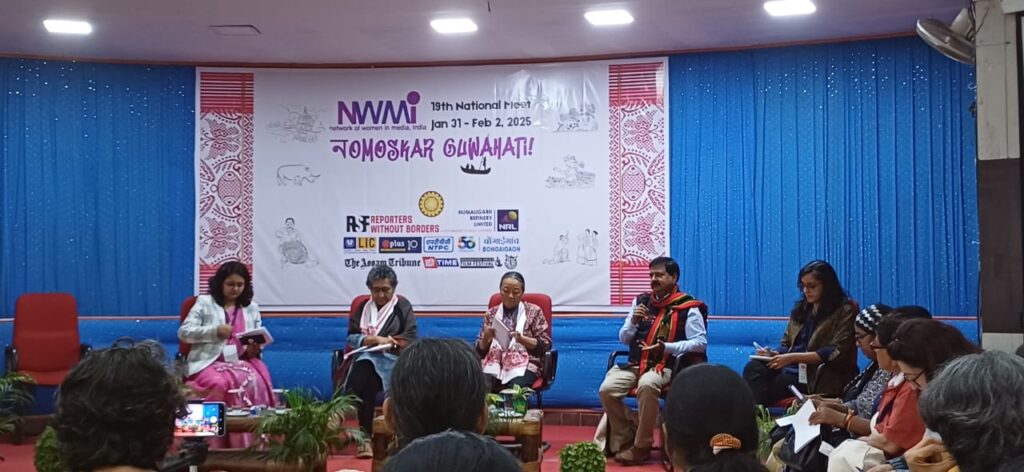
From left: Sushmita Goswami, journalist at Press Trust of India, Kalpana Sharma, independent journalist and author, Linda Chhakchhuak, independent journalist, Sushanto Talukdar, Editor of NEZine, and Rohini Mohan, independent journalist and author.
Journalists from the North-East and those who travel to the region for short periods to report on it, grapple with different sets of challenges, said participants in the second panel discussion during NWMI’s annual meeting in Guwahati (Jan 31-Feb 2, 2025) against the backdrop of the ongoing conflict in Manipur.
The session focused on reporting about the North-East, a region that was often neglected for being on the periphery of the Indian mainland but lay at the centre of vital debates about citizenship, federalism, internal colonisation, biodiversity and the climate crisis, the panellists said.
Sushmita Goswami, a Guwahati based journalist working at Press Trust of India, moderated the panel consisting of two journalists based in the North-East— Independent journalist Linda Chhakchhuak and Editor of NEZine, Sushanto Talukdar– and two from outside who have reported on the region–Independent journalists and authors—Kalpana Sharma and Rohini Mohan.
No matter what a journalist’s background, professional vetting processes are vital in ensuring accuracy and fairness, the panellists said.
About the critique of “Parachute Journalism,” Rohini Mohan said, a journalist, after all, is an outsider everywhere, with a desire to understand. Echoing her sentiment, Kalpana Sharma said “Is journalism going to be about– ‘I am the only one who is entitled to write about my area, my people, my problems?’ If it breaks down to that, then I think we are facing a true crisis.”
Different dilemmas
Reflecting the panel’s composition, a major part of the discussion focused on the dilemmas posed to insiders versus outsiders while covering the North-East.
Insiders, those who are rooted in the region, have to be particularly conscious of not allowing their identities to colour their coverage, said Sushanto Talukdar, who lives in Guwahati and has covered the region for decades. Insiders working for local media organisations may also be vulnerable to pressures from advertisers such as the state government and private entities, he said.
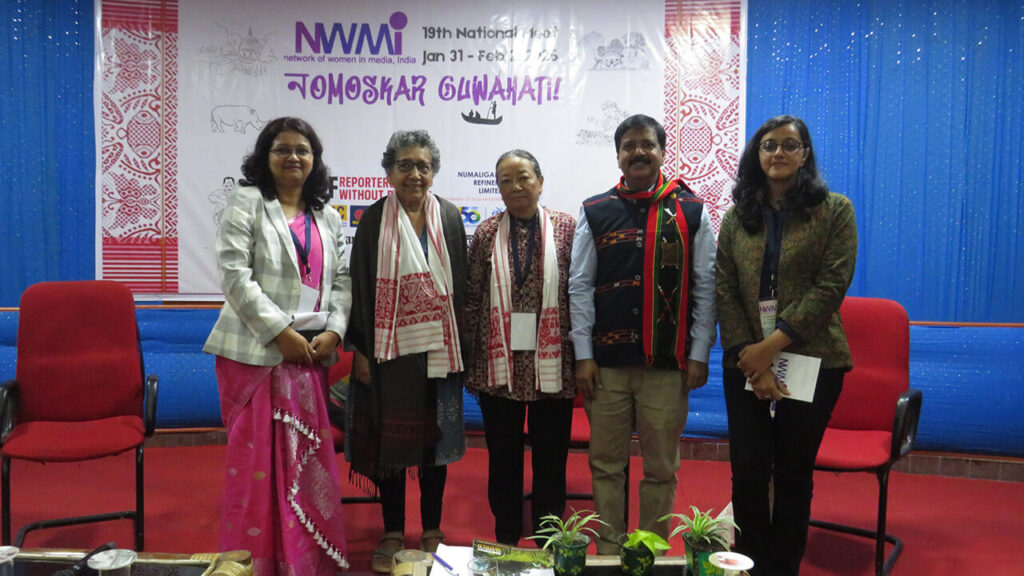
From left: Moderator Sushmita Goswami, Kalpana Sharma, Linda Chhakchhuak, Sushanto Talukdar and Rohini Mohan.
Outsiders, for their part, have to grapple with not being intimately familiar with the region’s social, cultural and historical context, a lacuna that they must fill by doing their homework before landing in the region, said Chhakchhuak, a veteran journalist based in Shillong.
Even journalists based in one part of the North-East need to realise that they are outsiders in other areas, Talukdar said, highlighting the region’s astonishing but underappreciated diversity, including the fact that it is home to speakers of more than 400 languages. “How can I claim to know Manipur if I visit it just twice or thrice in a year?,” he asked.
At the same time, outsiders might retain the ability to be surprised by developments that those closer to the action might take for granted, suggested Rohini Mohan. “Some advantages are that I get confounded perhaps more quickly and easily.” She said that she had also learnt from the inevitable criticism that came her way from locals because it pointed to the gaps in her understanding. “From there, I know what to go and read,” she said. As an outsider, she said that she gave herself time to get all sides of a story and process the information. “I resist the urge to write or say something immediately while I am reporting on a place,” which is a challenge in this digital age, Mohan said.
Outsiders can fruitfully collaborate with local journalists by travelling together, for one, in volatile situations, there is safety in numbers, she said. “For another, while locals can help with translating and quickly locating a story’s geographical hot spots, those on assignment for the national and international media might be able to open doors more easily and could bring a global perspective to a story,”she said.
Scene of action
Covering the North-East was vital because here one can see in action the effects of revolutionary changes that have swept the country’s media, economic and political landscapes over the past four decades, Sharma said. In this period, the media has expanded from print to include television and, more recently, digital platforms and social media. On the political front, the intensification of religious polarisation over the past decade has left its imprint on the North-East, as the conflict in Manipur reveals, while in the economic sphere, market-oriented policies have turned investors’ eyes to the resource-rich region.
Recalling her foray into reporting on the North-East, Sharma said, “I heard Assamese saying to me, we feel like a colony because we have natural resources… Delhi is only interested in us in order to extract as much as they can from us.”
Talukdar suggested that digital media could fill gaps and biases in coverage of the North-East region by allowing its inhabitants to tell their own stories. “We have to create our own space,” he said. But Sharma cautioned that while digital media had democratised journalism to an extent, this process also had downsides. One drawback was that such writing lacked the gatekeeping that defines journalism. Another was that it had led to a trend of people consuming information in silos in ways that confirm their biases, she said. “That is adding to the polarisation, and that is adding to our lack of understanding of complex issues,” she added.
Journalists should write about the North-East also because amidst a global climate crisis and ecological collapse, the region’s pristine forests, its agricultural methods, such as jhum cultivation, its biodiversity as well as the diversity of its traditions represent an alternative to the mainstream and to globalisation’s monoculture, said Chhakchhuak. “We are the ones who have the answers to some of the crises…in the world,” she said.
Report by Sumana Ramanan
Edited by Swagata Yadavar


