

In Uttarakhand, a Women’s Group is Taking Power Back From ‘Pradhan Patis’
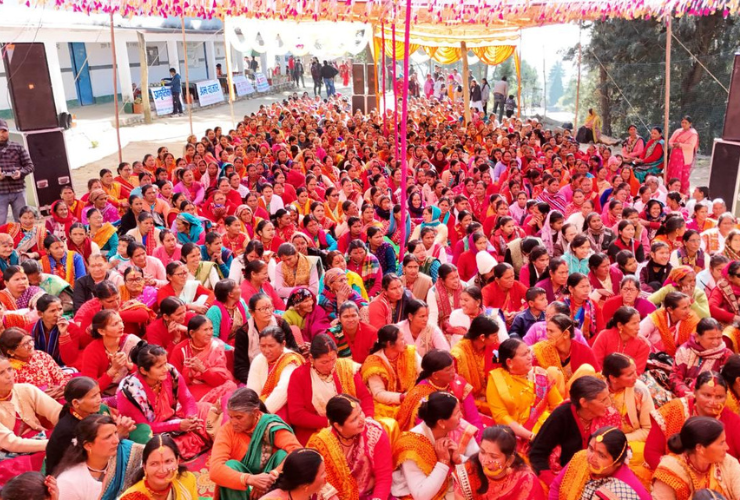
A meeting of the Rachnatmak Mahila Manch which has entered the panchayat elections in Uttarakhand. The women’s group is not associated with any political party. Photo courtesy: Special Arrangement
Last month, a women’s group in Uttarakhand entered the panchayat elections for the first time in Almora’s Salt block to challenge the proxy husband system—or husbands making administrative decisions on behalf of their wives who are elected to the panchayat—and won over half of the gram pradhan, or village head, posts they contested.
The group, Rachnatmak Mahila Manch, formed in 2013, had pledged to abolish the practice of pradhan pati (husbands of women in power running the show). The group, which is not registered as a political party, backed a total of 33 women—26 candidates fighting for the post of gram pradhan, six for various posts in block development councils, and one as zila panchayat member. It also extended support to 40 non-member candidates. The women contested as independent candidates as the party had refused to align with any of the three mainstream political parties—BJP, Congress, and Uttarakhand Kranti Dal.
The Salt block has 138 gram pradhan, 40 development council, and five zila panchayat seats. The elections were held in Salt on 28 July and the counting and announcements of the results took place on 31 July. Sixteen women, who are directly linked to the manch, won the pradhan posts, while three bagged block development council posts. Two of its members were elected unopposed as village heads.
“Now, we have the public calling these winners ‘pradhanji’, a term earlier reserved for their husbands. Earlier, even after having contested multiple times, the man became the pradhan de facto,” said Renuka, a manch member, who shed her caste surname after joining the group two years ago. “The candidates also asked their husbands not to campaign as they did not want people to be swayed by their influence,” she says. The group members fanned out across the block to campaign for the women they supported.
Though women have led Uttarakhand’s most significant grassroots struggles, from the Chipko movement of the 1970s to the anti-liquor agitations of later decades, these mobilisations often did not question caste or gender hierarchies. The success of this non-partisan group with strong grassroots backing indicates a critical shift. The manch proved that entrenched practices like the “pradhan pati” system are not cultural habits but political structures that can be dismantled when challenged by in an organised and community-driven way.
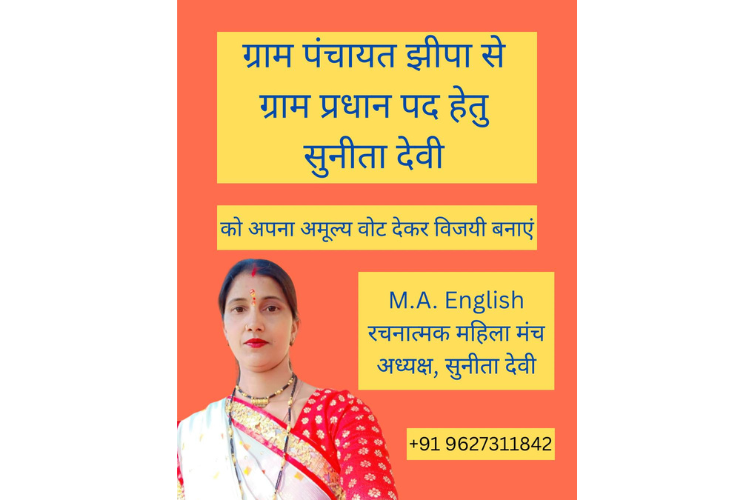
An election poster for Sunita Devi in Almora, Uttarakhand, who is backed by the Rachnatmak Mahila Manch. Photo courtesy: Special Arrangement.
At Almora’s Jheepa, a candidate’s poster departs from the usual template: Instead of her husband’s photograph and name, Sunita Devi smiles faintly, and below her picture in bold letters is her educational qualification: MA English. The 32-year-old president of the manch unsuccessfully contested the election for the post of gram pradhan. Devi, one of the women who decided to float the group as a bloc for the polls, said that their entry into politics will ensure that decision-making and self-governance will be helmed by women. “At gram panchayat meetings, we can barely attend as men monopolise all platforms. However, this time, we can see a difference because women candidates have started highlighting their identity over their husband’s,” Devi said.
The manch was founded to help women organise to demand compensation for human-wildlife conflict victims, farmers, and amplify the voices of ASHA and anganwadi workers. The group is an offshoot of the non-profit Shramyog, which has been working on social issues. A periodical with 40,000 subscribers funds its activities, says one of its founders, Shankar Datt, adding that the origins of the group date back to 2011. In the census, Almora had seen a negative decadal growth rate in population due to migration, prompting Datt to set up an institution to focus on the social capital of the region. “Over the last few years, communal polarisation has risen along with unemployment and alcohol consumption in the state, and our group, comprising unions of ASHA, anganwadi workers, farmers, and women, hopes to instil a sense of community in the region and fight against these issues,” Datt says.
The manch was later formed by the members of Shramyog to focus on the women in the region. Initially, they were 150 women from 11 villages. Now, the manch operates in 150 villages in Almora and Pauri Garhwal and has more than 1,500 members. It charges Rs 5 per head as annual subscription fees from its members to fund its activities. It has also helped women set up food processing units and connect them to markets. Their activities also find funds through the stalls these units set up during their annual meet-ups.
Even as women feel empowered to take up the leadership roles, they are forced to wage this struggle as villages increasingly empty out. “There are fewer men in villages because of migration to plains, so we had to step up to shine light on the perils of inhabiting a landscape shared with animals. Through an entry into the local government, we can address challenges in health, education, and labour sectors. All these years, work has been few and sparse. This can be changed with a network as wide as ours that closely works with people in the lowest rung,” Devi says.
The decision to take the electoral plunge was made at a cluster-level leader meeting of the nine “shram sakhis”—heads of the 11 clusters falling under the group—on Panchayati Raj Diwas on 24 April 2025, following which candidate selection was done in subsequent village-level meetings. Devi says the reason to enter politics was to seize power over the panchayat system and refine their negotiating power with the local authorities.
The manch is divided into 11 clusters, with each cluster covering 10-12 villages. A sharm sakhi leads each cluster by holding meetings with village representatives. These representatives then coordinate with members at the village level. While the cluster leaders meet every three months, the 1,500 members convene once a year in November, the only winter month in the region when the women are relatively less occupied.
Instead of relying on identity-based appeals, its candidates urged voters to look beyond social and political divides and judge them on the basis of their work. This approach, Renuka says, has exposed the BJP’s vulnerability. “The BJP fared poorly this time. By choosing to remain independent of any political affiliation, we reject any party patronage and want to garner legitimacy through performance,” she explains.
The manch aims to improve awareness in villages to free them of exploitation, and make them safe for children and women. Based on the foundation of social justice, the manch’s election manifesto is titled, ‘Our Gram Sabha, Our Rule – All work Through the Panchayat’ (humari gram sabha, humara raj, panchayaton se karwayenge sare kaaj) and promises to foster the spirit of community and abolish the practice of “pradhan pati”.
The model floated by the Mahila Manch by creating a local economy for women coupled with the opportunities ensured by 50 per cent reservations in the three-tier panchayat in Uttarakhand along with the rotational system to ensure equal participation for women, SC/ST, and OBC castes, is expected to create a more inclusive platform for women’s political participation.
Aiswarya Raj covers Uttarakhand as a correspondent for The Indian Express. Earlier, she was a city reporter in the national capital region, documenting stories from Southern Haryana. She first reported on the Rachnatmak Mahila Manch for The Indian Express.
Edited by Shalini Umachandran